This afternoon I received a bunch of data accompanied by stacked bar graphs for each dataset. For example, this one:
The chart shows the incidence of disease X in various age ranges. That incidence is split by 8 severity levels. The chart shows that the disease especially affects age ranges 4 and 5, at different severity levels. However I didn’t feel comfortable …
what are the different levels of severity in age ranges 1, 2 and 3?
how can we compare levels C, D and E in age ranges 4 and 5?
is there anywhere some severity A?
(it’s even worst when some age ranges don’t have any incidence at all: what is happening?)
This reminded me I read a book written by Steven Few, a few years ago: Information Dashboard Design (O’Reilly Media, 2006). Inside, on pages 135-136, one can read stacked bar graphs are the right choice only when you must display multiple instances of a whole and its parts, with emphasis primarily on the whole. And that this type of graph shouldn’t be used if the distribution changes must be shown more precisely.
If one wants to clearly display both the whole and its parts, Steven Few recommends to either use two graphs next to each other or a combination bar and line graph (with two quantitative scales).
As I’m not really interested in the whole but mainly in the parts and their relative distribution, I suggest another way to present the data. This isn’t really new. Actually everything was already in the table. You just format the table nicely and add some colour gradient. And voilà:
You still see where the incidence is the highest (in age ranges 4 and 5), what levels of severity are the most important (C, with lower but approximately similar levels of D, E and H). In addition to the graph above, one can notice there isn’t any severity levels A, B, F and G represented and we can quickly grasp the proportions between the different incidences.
Of course, if your criteria for “sexiness” is that there shouldn’t be any digit on your chart, then this chart is not sexy. But I find this presentation really more appealing and meaningful than the stacked bar graph. Isn’t it?
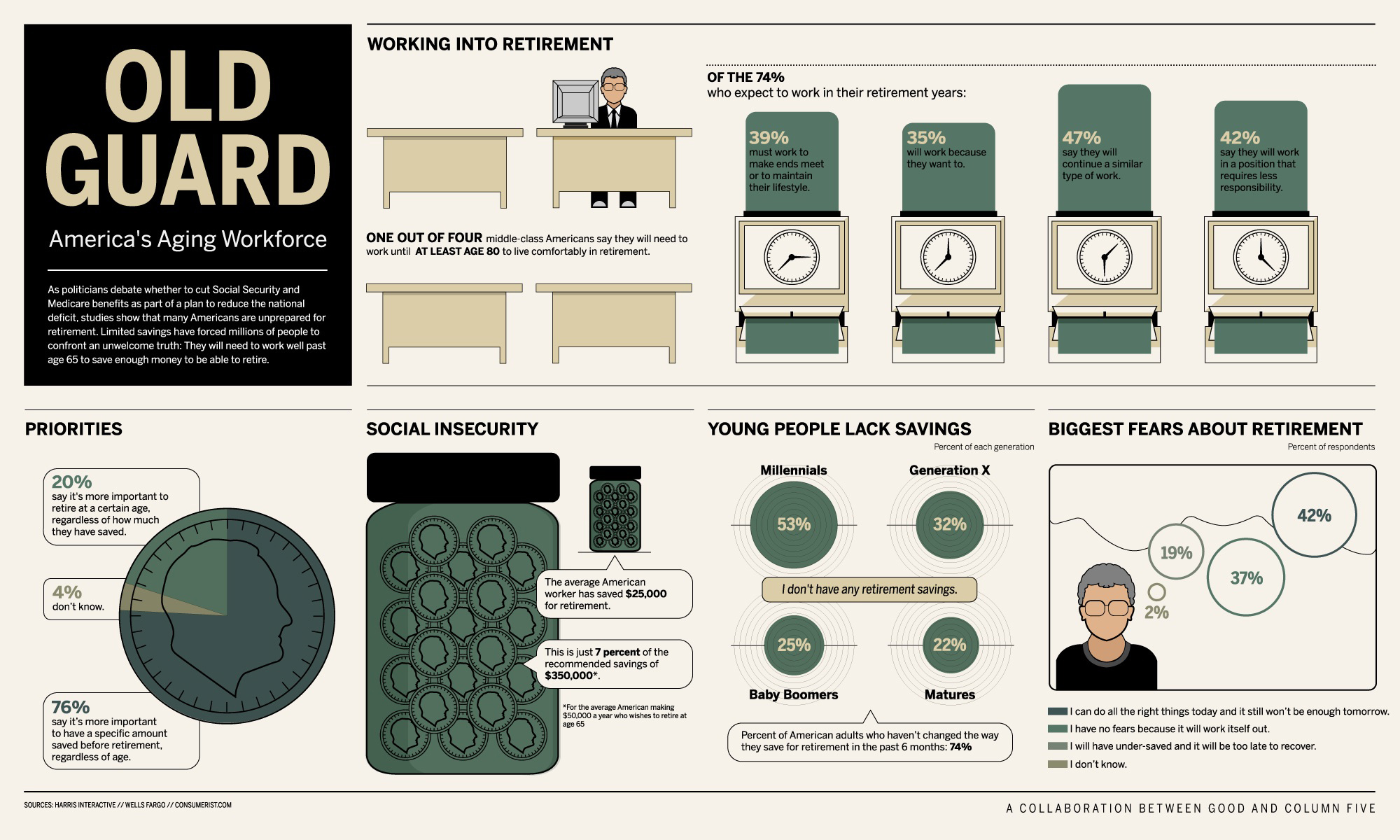
Yesterday, GOOD issued an infographic of America’s Aging Workforce (reproduced below). One of the key learning I take from it is that many Americans are unprepared for retirement. Indeed, the average American worker has saved $25,000 for retirement but it is estimated she/he will need $350,000 if she/he wishes to retire at 65 (i.e. 14 times more money!).
I was also wondering: after China and Belgium, how will the population age in the USA?
The US Census Bureau maintains national projections of the population and its latest data is from 2009. Among other things, it takes into account the resident population and demographic components of change (births, deaths, and net international migration). For international migration (in and out of the USA), there are four alternative assumptions (described in the method statement):
in the High Net International Migration scenario, they increase the previously projected net international migration by a fixed ratio ;
in the Low Net International Migration scenario, they decrease the same previously projected net international migration by the same fixed ratio ;
the Constant Net International Migration scenario illustrates the effect a level trend in international migration would have if maintained over the projection period ;
finally, in the Zero Net International Migration, the number of immigrants and emigrants is held constant at a value of zero for the entire projection period, thus assuming a closed population and no movement of individuals into or out of the United States.
By proceeding in this way, the overall number of migrants projected to enter or leave the population is (optionally) modified while maintaining the assumptions about the distributions of demographic characteristics.
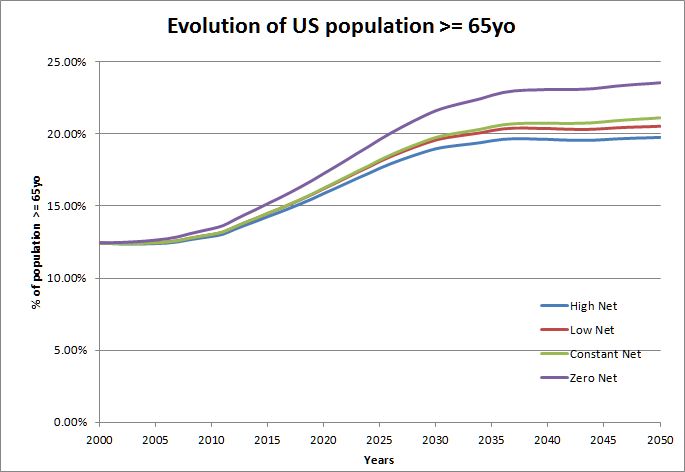
Now, as expected, the American population is indeed aging. From approximately 12% in 2000 the population above 64 years old will increase to more than 21% in 2050 (in the constant scenario, see below). We also see an acceleration of the increasing number of elderly in the USA between 2010 and 2030. This US estimation is a bit lower than the estimations for China (>23%) and Belgium (>25%).
In the graph above, I took the Constant Net International Migration scenario as I consider it as the most conservative. When one plots all the scenarii, we can see the difference is not so big: the US population above 64 years old in 2050 will be between 19% (High scenario) and 23% (Zero scenario) of the total US population (see below).
The main issue remains to maintain older people as much as possible the same levels of health and independence as they enjoyed during their active lives. As highlighted by GOOD, America’s workforce will need to work well past age 65 to save enough money for retirement.
Indeed: 2011 was the International Year of Chemistry (IYC). But why IUPAC and UNESCO dedicated a year to that basic science? It was for two reasons: one looking at the past and one looking at the future.
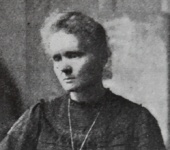
Looking at the past, 2011 was the 100th anniversary of Marie Curie‘s Nobel Prize in Chemistry for her discovery of the elements radium and polonium. She was the first woman to be awarded a Nobel Prize. And her discovery was very important for both the science in itself and its applications to health. Radium’s radioactivity seemed to contradict the principle of the conservation of energy. The discovery of radium allowed other great names in chemistry and physics like Rutherford to study the atom and radioactivity decay. In medicine, the radioactivity of radium allowed the development of radiation therapies, used to control or kill malignant cells in cancer treatment.
But 2011 was also the 100th anniversary of the first Solvay conference which subject was “Radiation and the Quanta”. Marie Curie was obviously present, along with Henri Poincaré, Max Planck, Ernest Rutherford and Albert Einstein among others. It was held at the Hotel Metropole, in Brussels (yes, in Belgium 🙂 ). Solvay conferences in physics and chemistry still continue now.
1911 Solvay conference
So IUPAC and UNESCO wanted to commemorate the achievements of chemistry and its contributions to the well-being of humankind in general. And 2011 was full of activities all over the world (there was probably one near your place and there are still plenty of activities prepared for 2012!).
One of these activities was the creation of a team of young people/scientists who debated and introduced their ideas and expectations from life sciences and chemistry, industry and governments to build a better world in 2050. I am grateful to my company to have chosen me to represent it in this “Young Leader” team: it really was a great experience!
Every member of the team came from different horizons (Europe, Asia, America, Africa) with different backgrounds all related in a way or another to chemistry (but it’s true that we were mostly chemists and engineers). We started by the simple statement that “chemistry is everywhere and for everyone“. It’s quite obvious but if we are often reminded of the negative impacts of chemical products and chemical reactions, chemistry also enabled billions of applications and made possible to feed more people, give them shelters and potentially a better health. It’s not roses all the way ; mankind has lots of efforts and progress to make. But if you think of the computer you are using to read this post, for instance: it’s working thanks to thousands of chemical compounds and chemical reactions. And on top of that, chemistry is also a natural process (well, first, it’s a natural process). When you eat your breakfast, when you listen to a lecture, when you attend a meeting, when you practice some sport, when you meet friends, when you sleep, you are full of chemical reactions, using thousand different chemical elements.
But as the world is facing important challenges like overpopulation, energy depletion, pollution, etc. or simply because people want to make their lives better it’s also true that chemistry is our future and will play a role in tackling these issues. But instead of depicting a sad, pessimistic view of these issues and just enumerating technical solution chemistry is or will be designing, the team decided to work on a vision for 2050 and ways towards this vision:
By 2050 we must all have access to healthy, safe and fulfilled lives in symbiosis with our planet
With concrete examples of existing or budding chemical technologies and solutions allowed by the development of chemistry, we wrote three concrete stories of people who would have made a change in the future. Most megatrends were debated, lots of research was done to find scientific evidences of change or application. Better water distribution and usage, smarter housing, increased yields for locally produced food, more efficient energy production and storage mechanisms were among the topics we discussed. Health was also present as education, biotechnologies (like new delivery and detection methods), collaborations and policies also play a key role, with chemistry as a pervasive partner.
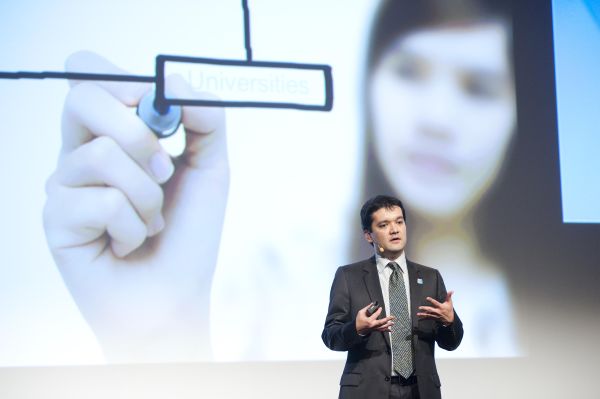
A milestone for the group was the Closing Ceremony of the IYC that was held in Brussels, on December 1st, 2011. We had to transmit that vision, the way we think it can be achieved to students and members of the chemistry community. It was a great pleasure to see the high level of interest and, for most of them, of passion the young students have towards Chemistry. Their questions, their curiosity about the future, their questioning of the implementation of our vision as well and their thirst of knowledge were amazing. It was also very, very interesting to listen to Ada Yonath’s talk about ribosomes but also science, curiosity and her passion. Professor Jean-Luc Brédas, Francqui Prize in 1997, also gave a very interesting talk about new and more efficient energy sources. Finally, the debate, the round table between main actors in the world of chemistry, the ideas, comments, discussions that followed were all very instructive and enlightening.
Fortunately this is not the end. All these ideas and discussions will definitely feed discussions and our efforts to maintain a platform for chemistry and its ways to help for a better future. We already started with a Facebook group. Central science created special topics about IYC activities. Nature created an IYC website with dozens of articles about everything from research to careers. And I hope to be able to write again about other initiative and, of course, about the fulfillment of our vision in 2050 (or even before!).
Photo credits: Marie Curie, from Scientific American by Wyoming_Jackrabbit (CC-by-nc-sa on Flickr). The photo of the Solvay conference was taken by Benjamin Couprie and from wikipedia. Photos of the YL group and the closing ceremony are from Vivian Hertz.
When I wrote my last post, videos of health talks at TEDxBrussels were not out yet. Now they are and you can watch them below …
First Andrew Hessel started by talking about synthetic biology, biotechnologies and his participation in the open source biology movement. One day, there will be an org (organism) for the things you want to do.
Then Jack Tiszynski followed with the drastic idea of replacing doctors by software for diagnostics and brought the idea that we will have a “virtual double” in our future smartphones. This double will know our predisposition to diseases and suggest prevention methods and cures.
Finally David Duncan talked about extreme ageing and some of the important issues brought by prolonging life and being healthy for a longer period of time than before.
But among talks I didn’t attend, Peter Hinssen presented his idea of S-curve for the future and especially the future of healthcare. For him, the flip in healthcare didn’t occur yet. But he can already predict that health will become more personal, more numerical, more proactive, more community-oriented. That’s funny because he put words on part of what we are going to say at the closing ceremony of the International Year of Chemistry, this Thursday in Brussels. Hope to have the same vibrant words 😉
TEDxBrussels is a local, self-organized event that brings a TED-like experience to Brussels. I already often mentioned videos and presentations from TED (for instance here, here or here). When I read that it will again be organized in Brussels in 2011 I decided to attend this edition. Here is a short summary of this intense day with my tweets and the just-released videos. It would be very time consuming to write about each and every talk. Here I will just highlight speakers I like the most (you can have a look at TEDxBrussels website for the complete list of speakers).
22.11.11-09.09: Tell people you work in a #pharma company and you immediately get questions on #ethics. Yes it’s an ethical business!
One of the nice thing about a TED event is that you get to see many new people, most of them very interesting with cool background, strange or simply something nice to say. And, yes, when you tell people you are working in the pharmaceutical industry, questions on ethics immediately pop up 🙂
22.11.11-09.40: Nice sweet talk from Cuartielles at #tedxbrussels #arduino. Learn by doing.
One of the first talks was from David Cuartielles on the Arduino project. His talk was like a reminder that life is still very physical and the Arduino project is a good example of “open source hardware” and of “leaning by doing”. It reminded me that when I will have time, I would really like to play with the Arduino!
Also embedded in physical life were talks by Henrik Scharfe (F-Geminoid) and Ken Haase (E Pluribus Unum). Hasan Elahi (Hiding in plain sight) and Kaliya Hamlin (Identity) introduced concepts of radical transparency and participatory totalitarianism (respectively). And during that time, many people were logged in Facebook, Twitter and many other social networks, updating their status, giving everybody parts of their lives and, for most of them, using their unique identity given at birth.
22.11.11-10.28: #eyeborg Spence at #tedxbrussels: I’m not an expert but I have a camera in my eye
Then we went back to hardware with Rob Spence talking about the camera he used to have in place of his eye. It was also interesting to discover how people improved a lot prosthetic arms, legs (and eye thus). I found also cool the augmented reality that was displayed in the fireman mask as well as the simple way a fireman can change this display.
22.11.11-11.16: #smartcars are not just cool tech projects, they can solve some current issues. Waiting for #collaboration between them. #tedxbrussels
Raul Rojas presented his team’s “car that think”. Again, it was very interesting to see how technology evolved: this VW can drive all alone in the traffic in Berlin! It seems that cars are becoming “smarter”. But I thought he would touch the fact these smart cars can autonomously collaborate between themselves (once they are more than one). Then these smartcars could one day outperform human drivers in heavy traffic.
22.11.11-11.27: High concentration of #apple products at #tedxbrussels. Feeling a bit lonely with my #moleskine and #pen 🙂
And if we stay in hardware, there was an awful lot of MacBooks, iPads, iPhones, IObjects in the audience. And even some speakers brought Apple products on stage. I just had a moleskine and a pen to take some notes. My Android phone was way enough to update Twitter 🙂 (but it was definitely not good at taking pictures in the feeble light during talks).
22.11.11-13.16: Great talks from Ashdown, Meyer (entrepreneurship), Hypponen, Janah (microwork) & Chakrabarti (education+) this morning at #tedxbrussels 🙂
The end of the morning was filled with interesting presentations from Paddy Ashdown (Why the world will never be the same …), Mikko H. Hypponen (Definding the net), Julie Meyer, Leila Janah (see below for the previous 2 people’s videos) and Kushal Chakrabarti (What does education mean to you?). While both have their own qualities and bring work to the world, it was interesting to compare the personnalities of Julie Meyer (more formal, on the financial side, “money follows ideas”, presentation with the logo of her company on top right, helping individual entrepreneurs) …
and Leila Janah’s (less formal, playing more with emotions, “technology must serve humanity”, more “web 2.0” presentation, being an entrepreneur and helping individuals getting jobs in the same company (hers)).
22.11.11-07: Wonderful and breathtaking para-music #tedxbrussels
22.11.11-15.41: Strange talk about death bed visitors by Fenwick #tedxbrussels
And it continued with a very strange presentation (imho, ymmv) about dying well by Peter Fenwick!
22.11.11-16.45: I should have danced my PhD 🙂 #tedxbrussels
Then we saw an effective way to present what Ph.D. students are doing: dance (John Bohannon and the Black Label Movement)!
22.11.11-16:57: From Oxford or not, a video link is unfortunately still less powerful than a live talk #tedxbrussels
The Science section started with a video conference from David Deutsch (The Unknowable …). His talk was very interesting but nothing will beat a real, live talk, especially if the professor on the other side of the video link is … well, teaching like a professor.
22.11.11-18.31: @xprize I would prize simple delivery system and tech that drastically improve basic sanitation+health issues for 10mio people #tedxbrussels
Deutsch was followed by a presentation of what does the XPrize Foundation by Eileen Bartholomew. In the end, she asked for feedback and what we would like the XPrize Foundation to support. I think that tackling basic health issues will not be very difficult; getting money for less developed countries can be the problem and that’s where the Foundation can help. Solutions submitted to this hypothetical prize won’t necessarily be using the latest, cool hi-tech of the moment but I’m sure they can be very effective. Leveraging power, they said.
22.11.11-17.16: Interesting futuristic story from Marc Millis #tedxbrussels
And after these two high-level talks we went back to science fiction with Marc Millis telling his story going to other planets (“colonies”) in space. That was relaxing (btw, he was sitting on a sofa).
22.11.11-17.39: Great session on the future of biology and health – at least for a biologist #tedxbrussels
22.11.11-18.35: Intetesting perspectives on bioengineering (Hessel), fut medicine (Tuszynski) and ageing (Duncan) #tedxbrussels
Then, as a finale, 3 talks on biology and health! Yippee! Andrew Hessel started by talking about synthetic biology, biotechnologies and his participation in the open source biology movement. One day, there will be an org (organism) for the things you want to do. Jack Tiszynski followed with the drastic idea of replacing doctors by software for diagnostics and brought the idea that we will have a “virtual double” in our future smartphones. This double will know our predisposition to diseases and suggest prevention methods and cures. Finally David Duncan talked about extreme ageing and some of the important issues brought by prolonging life and being healthy for a longer period of time than before. (I wish the videos were already on the website!)
22.11.11-18.37: Overall, loved this first #tedxbrussels experience! 🙂
I unfortunately didn’t have time to attend the last part of the session (damn!). But anyway, thanks to the organizers for this edition of TEDxBrussels! Even if all of them are not relevant to your job or will not be applicable before a long time, it gives you lots of ideas and it will take me some time to explore more in details some (many) of them. I started by collecting direct links to presentations above on Pinboard. Feel free to use them as starting point too!
The NPR has produced a nice visualization / video showing how population grew to 7 billion (original article):
If you want to model the improvement in child survival, you just turn the birth tap off (or nearly). Then, with wealth, prevention, healthcare and better food, the population will also grow older (death tap also turned off or nearly) and during a certain time, lots of adults will be economically active (i.e. they will work and consume). This is a demographic dividend. But it comes with a risk: at the next stage, there might be a disproportionately high number of people compared to / depending on a small number of active adults (the next generation). In addition, if you fill it up slowly but you also empty it slowly, the container risk to be full soon, it all depends on the various rates …
The United Nations Development Programme (UNDP) released its Human Development Report 2011. It “argues that the urgent global challenges of sustainability and equity must be addressed together – and identifies policies on the national and global level that could spur mutually reinforcing progress towards these interlinked goals“.
In this report, there is a ranking, the Human Development Index (HDI). The HDI is a way to measure the development. It combines indicators in three main dimensions: health, education and living standards. The mathematical way used to combine these indicators is explained in a technical note (PDF). The interest is of course to have a single number to use in comparison for both social and economic development. It’s not the only element to take into account to compare development. It’s merely a starting point giving an overview of development. An in-depth discussion about development and comparison between countries will need to go further and analyze each indicator separately (as well as other indicators if possible).
But human nature likes rankings. So be it. Here are the top 10 countries according this HDI:
1
Norway
0.943
2
Australia
0.929
3
Netherlands
0.910
4
United States
0.910
5
New Zealand
0.908
6
Canada
0.908
7
Ireland
0.908
8
Liechtenstein
0.905
9
Germany
0.905
10
Sweden
0.904
And the 10 least developed countries are all in Africa (again, according to the HDI):
178
Guinea
0.344
179
Central African Republic
0.343
180
Sierra Leone
0.336
181
Burkina Faso
0.331
182
Liberia
0.329
183
Chad
0.328
184
Mozambique
0.322
185
Burundi
0.316
186
Niger
0.295
187
Democratic Republic of the Congo
0.286
For information, China is 101st with an HDI of 0.687 ; Vietnam is 128th with an HDI of 0.593 ; India is 134th with an HDI of 0.547 (all three in the group of medium human development countries).
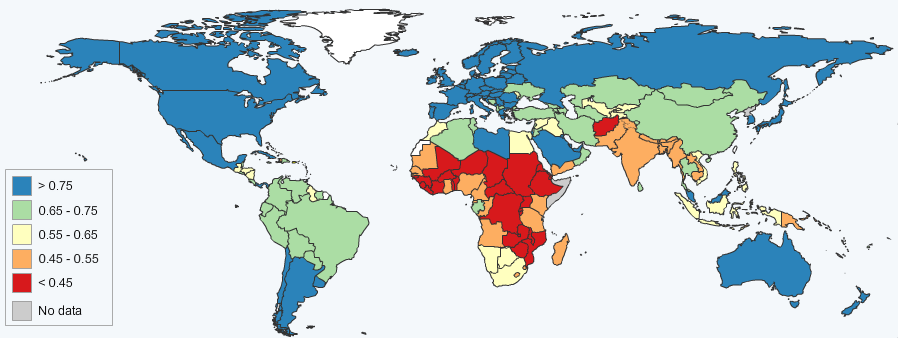
If I put all this in a map, it gives (thanks to the UNDP Statplanet tool):
Now the HDI is admittedly a theoretical value: it doesn’t take into account inequalities within each specific country. That’s the reason why the UNDP created in 2010 the Inequality-adjusted Human Development Index (IHDI). The IHDI is thus the actual level of human development (taking into account inequality). The average loss in the HDI due to inequality is about 23%. And although the loss is variable from country to country, it increases on average when you go down the human development index (HDI), see figure below. This average loss is the smallest in Europe and Central Asia (-12.7%) and the biggest in Sub-Saharan Africa (-34.5%).
In this presentation, Hand Rosling made a small recap of the situation in 1960, when the world was divided between 1 billion wealthy people and 2 billion poor people. He made this situation more obvious by plotting the number of children per women -vs- the percentage of child survival.
Then, if you watch the movie (watch it at the end of this post), you’ll see how the different populations evolved to the situation of 2005 where the differences were still there but less marked than in 1960. And all this was thanks to soap, hygiene, education, vaccination, family planning, …
So, one thing is to worry about what would be the world with 7 or 9 billion people. Another thing is to prepare the environment (i.e. both our container – the earth, its ecosystems, its water resources, etc. – and its content – us, other animals and plants, etc.) to cope with such an amount of people. And a third thing is to try to curb that curve and find ways to slow the world population progression.
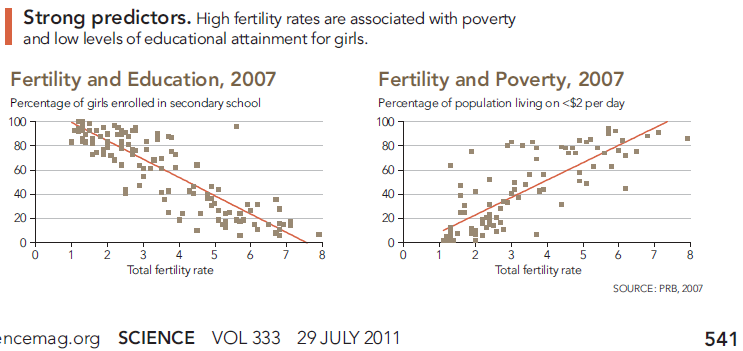
In the remaining of his talk, Hans Rosling states that one way to curb this population growth is to continue to improve child survival to 90%. This would help reach a sustainable size population of the world. Unfortunately there isn’t any “gold recipe” in order to improve child survival. Two general goals can achieve this (as well as achieve many other things): an improvement in education and a reduction in poverty.
If you improve education (especially of girls/women because they will become/are mothers, they could give their voice in that matter if we give them enough power), you will decrease fertility. The less children you have, the more time you have to take care of each of them, to give them more education, to feed them properly. On the other hand, if you reduce poverty, you also decrease fertility and, at the same time, you have more wealth to take care of your children, to send them to school and to give them proper food. This is not always the case, just generally the case.
Improving child survival will not solve all the issues. An addition of 2 billion people during the next 35 years or so is something big and it will have an impact of every aspect of our lives. But I really like the idea of having a leveraging effect starting from the improvement of child survival.
For once, I won’t write about a day here but about a week: this week is the Open Access week (OA week). In this fourth edition, it’s not time anymore to explain one more time what is Open Access (but if you still want to read about it, read the Wikipedia article or Peter Suber’s overview). This year, this week is defined as “an opportunity […] to continue to learn about the potential benefits of Open Access, to share what they’ve learned with colleagues, and to help inspire wider participation in helping to make Open Access a new norm in scholarship and research“.
Other Belgian universities usually support Open Access without any specific action about this week (except ULB with a recap mainly on the financial benefits). Is it a sign that Open Access is losing momentum or just became part of everyday life in universities?
Malaria is the 5th cause of death in low-income countries (according to WHO). That’s why I’m very happy to read that a malaria vaccine showed promising results in a phase 3 clinical trial (in The Guardian, The New York Times or Google News). As usual, I find very interesting to get all the information at the source: the original scientific paper was just published in The New England Journal of Medicine.
The main result of this study is that “the vaccine reduced malaria by half in [young] children […] during the 12 months after vaccination”. The study also showed that “the vaccine has the potential to have an important effect on the burden of malaria in young African children“. The conclusion of the article ends with “additional information on vaccine efficacy among young infants and the duration of protection will be critical to determining how this vaccine could be used most effectively to control malaria“.
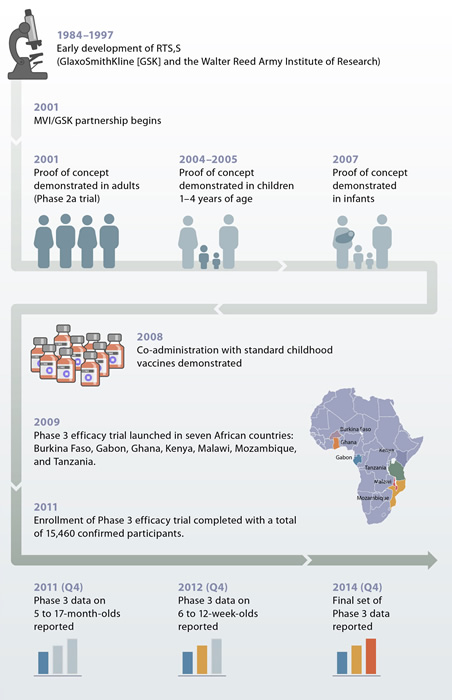
Indeed, as highlighted by the timeline reproduced below, the clinical trial isn’t over yet. Some data still needs to be reported (regarding younger children and duration of protection, as stated above).
If you want to follow what’s happening with this vaccine, the PATH Malaria Vaccine Initiative seeks “to accelerate the development of malaria vaccines and ensure their availability and accessibility in the developing world” and their website contains lots of useful information.
Disclaimer: I’m currently working for the pharmaceutical company that discovered and produced the RTS,S vaccine in this study. I’m however not part of the malaria team in any way. There is only publicly available information in this post.







 Jean-Etienne's blog
