FluTE makefile for wxDev-C++ (Windows)

FluTE is an influenza epidemic simulation model written by Dennis L. Chao at CSQUID. It works out-of-the box on GNU/Linux (just type make and run it).

I wanted to see how it works. But since I’m temporarily stuck with a Windows laptop, I downloaded a free C++ compiler for Windows (wxDev-C++), imported all the files in a project and compiled. For those who want to try, here is the project file and the specific makefile in a zip file (2 kb). Just decompress the FluTE archive (I used version 1.15), copy the two files from the zip file above and launch the IDE. In the project options (Alt+P), specify the custom makefile (in the "Makefile" tab) as the one from the zip file above. Compile (Ctrl+F9). Done.

On my Intel Core2 Duo T5450 (2Gb RAM), it took 6 minutes to simulate the "two-dose" example.

Please note that I didn’t try to compile with OpenMPI. Maybe for next time.

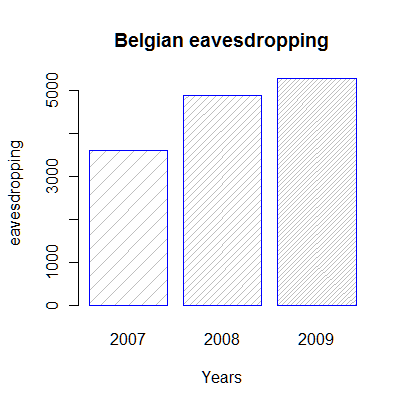
Belgian eavesdropping increased in 2009

Following this article (French), official phone eavesdroppings again increased in Belgium in 2009: Belgian police listened 5265 times to private conversations. The French transcript is here.

Evolution of the number of official eavesdropping in Belgium

One doesn’t get much more than these numbers: nothing about the number of hours spent listening, nothing about the percentage of effectiveness/results, nothing about internet eavesdropping (e-mail e.g.). One thing struck me: all requests for eavesdropping were accepted. Or, at least that what the Minister implied when he wrote “there is no distinction between the number of requests and the number of effective eavesdropping”.

Volcano and CO2 (bis)

Well, now I understand a bit better why experts said the small fall in carbon emissions indirectly due to the volcano is unlikely to have any significant impact on climate (see previous post) … InformationIsBeautiful made a correction following comments and the difference in CO2 emission is smaller:

Comparison of C02 emission by InformationIsBeautiful

However, although the air traffic is to slowly come back to normal, we can still enjoy some very nice moment without any plane in the sky:

Still no plane by jepoirrier on Flickr

Volcano and CO2

One side-effect of the eruption of the Eyjafjallajoekull volcano is that there is no more plane in the European sky for the last few days. On one side, people are obliged to stay longer on holidays, others can’t make business trips, some food and other items can’t be transported, plane companies are crying but train and coach ones are more than happy. The last week-end was sunny and a lot of people enjoyed going outside in North Europe.

Lavender Ash Cloud from tj.blackwell on Flickr

This morning, stuck in a traffic jam, I was wondering what is the amount of CO2 emissions saved by forcing planes to stay on the ground. And I found this great illustration from Information Is Beautiful:

planes or volcanos from InformationIsBeautiful

So, visually, forcing planes to stay on the ground has an impact. But experts says although this has caused a small fall in carbon emissions, it is unlikely to have any significant impact on climate (cited by The Guardian). I don’t really know who these experts are. I guess the newspaper wants us to believe what it wrotes as is. But continuing reading about the subject, one learns that although the industry seems to take the pollution aspect of flights into consideration, we are far from perfection.

Finally, what I like the most in this illustration, it’s that it’s backed by real data (see at the bottom of the cited post). BlueSkyModel.org also has some data on how to compute a flight carbon footprint.

Credits:
First illustration: Lavender Ash Cloud from tj.blackwell on Flickr
Second illustration: Planes or volcanos from InformationIsBeautiful.

Ph.D. thesis

As I promised before, you’ll find here the text and slides of my Ph.D. thesis (btw text and slides are in French). The oral presentation was on March 24th, 2010 and everything was fine 🙂 Slides can be watched below.

Software license and use of end-product

In one of his buzz, Cédric Bonhomme drew my attention on the Highcharts javascript library. This library can produce beautiful charts of various types with some Ajax interaction. The only negative point imho is that it is dual-licensed and all cases deprive you from your freedom:

  • there is a first Creative Commons Attribution-NonCommercial 3.0 License: you can use the library for your non-profit website (see details on the licensing page) ;
  • there is a commercial license for any other website.

Now what if we only need the end-product, i.e. the resulting chart, in a commercial environment? What is covered by the license is just the re-use of the javascript library in a website, not the resulting chart. If a company choose to use Highcharts internally to render some beautiful charts and just publish (*) the resulting image, I guess they can just download the library and use it (* by “publishing”, I mean: publish a scientific paper in a peer-reviewed journal, not publishing on its website). On the other hand, no one ever questioned the fact commercial companies have licenses for all the proprietary software they use to produce anything else, from charts to statistical data, just because they publish results with these software as tools. So the “trick” here would be that, by changing the medium on which you display end-results (from website to paper, even if it’s in PDF on the journal website), you can use the free-to-download license, even in a commercial environment, for an article from a commercial company. I’m not sure this was the original intention of Highslide Software.

A new website for Open Clip Art Library

Open Clip Art Library logo A small post to welcome the new website for the Open Clip Art Library (OCAL). The OCAL was created more than 6 years ago and now has more than 24.000 vector illustrations in the Public Domain (in the SVG format that can be read by most graphic software). For me, a major improvement is the direct visualisation of thumbnails. In the previous version of the website, it was indeed painfull to open each result of a search in order to see if the illustration was what one was looking for. I’m using the Library since a few years and I am always amazed at the quality of most illustrations in the science and biology sections (the two sections I use the most).

So, if you didn’t know OCAL or didn’t have a look at it since a long time, it’s worth visiting their new website now!

Every year the same?

Every year, same resolutions. And same end? As I did previous years, I promised to myself to update this blog more often but it seems “daily life” events caught me up.

This year, I resigned from my position at Callataÿ & Wouters (C&W). A lot can be said and written but overall, it was an interesting experience. I’ve learned a lot about software development and how to manage people (or not). Finally, I’ve met some very interesting people. Let’s close this chapter now.

Open space office


This year, I finally finished my Ph.D. thesis! The public defense will be on March 24th, 2010 in Liege (Roskam lecture hall). I’ll talk about rat hippocampus, proteins, stress, sleep (deprivation) and cognition. The final text will be available here after that.

And finally, I’m joining GSK biologicals. This is a new challenge but, from what I’ve seen so far, I think I’ll enjoy it a lot!

So I hope to resume posting more frequently on this blog (and with stuff more interesting than my own personal life) 🙂 Stay tuned!

Belgian State Security report 2008

When I first opened the Belgian State Security Report 2008 (PDF in French or in Dutch), I had the a feeling of déjà vu: the cover picture is in fact a part of the Great Court of the British Museum in London, UK. Strange for a report on Belgian security and surveillance …

The British Museum as illustration for a Security report
Comparison between an actual photo of the British Museum Great Court (left, by Guillermo Viciano, under CC-by-sa) and the cover of the Belgian State Security Report 2008 (right)

Then I saw it’s only a light version for the web, not the full version. I had a look at the Justice website and the Security web page but I couldn’t find the original version (if you have the full version, I’m interested).

The report summarizes all the activities done by the Security in 2008, including the groups, countries and activities watched, a report on the cases where it was involved (Belliraj, Benali, Trabelsi cases, a.o.) and a broad view of what they did to check people background, protect some others and check various accreditations.

The most interesting part for me, however, was a short description of a bill about data collection methods by the Security. This bill was submitted to the Belgian Senate in December 2008 and was recently adopted (the full text is here, in French). It’s now submitted to the Belgian king for signature.

Briefly, this bill modifies an existing law from 1998 and, among other things, tells apart ordinary data collection methods from specific (articles 18/7 and 18/8) and exceptional ones (articles starting from 18/9). As expected, the bill allows the use of techniques to intercept and read private communications between persons. The bill also allows entering into computer systems, removing protections, installing spyware, decrypting and collecting data (but it does not allow their destruction).

All these methods are controlled post hoc by two different bodies, an ad hoc administrative commission composed of magistrates (renewed each year by the king following a suggestion by the government) and a permanent “R” committee. Specific and exceptional methods needs to be approved first by the administrative commission but there is always the possibility for the Security hierarchy to bypass this and send a written notice to the commission later on. How many times can this last step be forgotten?

Although it’s nice to have the reference to the bill and be able to look for it on the internet, I would have liked to see some statistics about how many times these specific and exceptional measures were applied, how many times they were refused by the administrative commission, how many times the hierarchy allowed a mission and informed the commission later on, etc. in the same way they proudly show graphs of the number of hours spent protecting VIPs. I know details are protected by secret but it would still have been nice to have an idea on how often these methods are used.