
Today is the Indian Independence Day.
Photo credit: Boy holding Indian flag by myself on Flickr (CC-by-sa)
A blog about health economics, public health issues, free software, and probably everything else too …
Today is the Indian Independence Day.
Photo credit: Boy holding Indian flag by myself on Flickr (CC-by-sa)
 Three years ago, I wrote about JoVE, the Journal of Visualized Experiments. JoVE was a peer reviewed, open access, online journal devoted to the publication of biological research in a video format. I recently discovered that since 2009, JoVE is now just a peer reviewed,
 open access, online journal devoted to the publication of biological research in a video format. You can debate at length on whether JoVE was Open Access (as I thought) or not. I just think it’s sad although I understand their motives: in a recent exchange with them, they wrote they “handle most production of our content [themselves] and it is a very very costly operation”.
The recent exchange I had with Jove was about another previous post describing a way to store the videos locally, as anyone would do with Open Access articles in PDF format. I was unaware of two things:
Unfortunately, this trick will not work anymore in the coming weeks since they will “do token authentication with [their] CDN“. JoVE will remain for me a very interesting journal with videos of quality and without any equivalent yet (SciVee doesn’t play in the same playground and I wonder why Research Explainer missed the comparison in their 2010 interview).
I was then wondering what could have been the impact of this decision on the number of videos published in JoVE as free access. I didn’t find any statistics related to this on the JoVE website (unrelated thought: I like the way BioMed Central gives access to its whole corpus). I then relied on PubMed to find all the indexed articles from JoVE and relied on its classification of “Free Full Text” (i.e. copied on the PubMed Central website, including the video). At the time of writing (August 2011), on a total of 1191 indexed articles, 404 are “Free Full Text”. This is nearly 34% of all JoVE articles. When you split this by year since 2006 (when JoVE went online), you obtain the following table and chart:
| Year | All articles | Free Full Text articles | Note |
| 2006 | 18 | 18 | Full free access |
| 2007 | 127 | 127 | Full free access |
| 2008 | 115 | 87 | |
| 2009 | 217 | 118 | Introduction of Closed Access |
| 2010 | 358 | 42 | |
| 2011 | 356 | 12 | So far (August 2011) |
| 2011 | 534 | 18 | Extrapolation to full year keeping the same proportion |

As we can see on the left chart, plotting the total number of articles in JoVE -vs- time, there is a steady increase in the number of articles since 2006. This tend to prove that more and more scientists enjoy publishing videos. It would be nice to have access to JoVE statistics in order to see if there is the same increase in the overall number of views of all videos. With “web 2.0” and broadband access in universities, I guess we would see this increase.
However, as we can see on the right chart, plotting the percentage of JoVE “Free Full Texts” in PubMed -vs- time, there is a dramatic decrease in the percentage of Free Full Texts in JoVE since 2008-2009. Less and less videos are published and available for free in PubMed Central. This is unfortunate for the reader without subscription. This may also be unfortunate for the publisher since there are less and less authors over time who pay the premium for free access. But since authors also pays for closed access, there is certainly a financial equilibrium.
Some methodological caveats … The PMC Free Full Texts are not necessarily in free access on the JoVE website (and vice-versa ; all the ones I checked are but I didn’t check all of them!). This might explain why there is already a reduction in Free Full Texts in PMC in 2008 while JoVE closed their journal in April 2009. I expected the same proportion of free articles published until the end of 2011 than in the beginning of 2011 ; this might not be the case (let’s see in January 2012 ; this also leads to the question: “is there a seasonal trend in publishing in JoVE?”).
What I take as a (obvious) message is that if authors can pay less for the same publication, they will, regardless of how accessible and affordable the publication will be for the reader. I don’t blame anyone. But I can’t help thinking the Open Access model is better for the universal access to knowledge.
Photo credit: Sorry We’re Closed by Cinderella on Flickr (CC-by-nc-sa)
Following some comments on the dependency to version 4 of the .Net framework, I rewrote ForbidSleepingMode in C++. You can open and compile the project with Qt (open source). The source code is of course updated. The mandatory screenshot as well 🙂
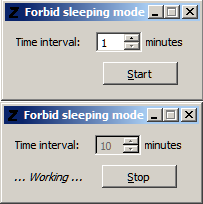
As you can see, I took the opportunity to add a small field where you can specify your own interval at which the program will “tickle” your computer.
Historically, computers were invented to solve issues in the factory or the office (university office or company office) but recently invaded home and are becoming ubiquitous.

At the beginning of this invasion, computers for home were (and are still) very similar to the ones for the industry/office: a CPU, a keyboard to enter data or commands and a screen to see what was happening. Artifacts to be attached to the computer were first invented for the corporate world and then progressively entered into homes. I still remember the first mouse we had at home: it was like a mini-revolution. After years there were still some software that could not take advantage of it or its usage was implemented but in a rudimentary way. Idem for the first webcam we acquired: only the provided software was able to use it. Now it comes embedded in most computer screen and can be used for various purposes (video chat, take pictures, read bar codes, art, …).
More and more, computers are now declined its various avatars like calculators, mobile phones, game consoles, car dashboards, ATMs, cashiers, … All of them affect our daily lives in a way or another. But in my opinion the computer shouldn’t have left the corporate world. Its home avatars should have directly been via adapted technologies. Because Mr. and Mrs. Everyone don’t need any computer at home.
Although some bosses want their employees to behave differently, the factory/office is were we work and home is were we don’t work. At home, we read, eat, sleep, play, interact with other family members and neighbors, perform personal care, watch the television, etc. None of these activities requires a computer as we know it (CPU, keyboard, mouse and screen). However some of them can be enhanced or at least affected by it.
Whatever how it is materialized, a “computer” can enhance your reading experience. It can monitor your sleep while you snore or, more broadly, it can monitor your health while performing your daily activities. Computers can enhance your movie experience (by linking to related content, e.g.). They can help you improve your cooking skills and watch your savings.
Without pretending to know the future, I think miniaturization is and will put thing back “in order”: you will no longer have a computer on your desk but a bunch of small devices, each of them responsible for a small part of your daily life activities. You probably already have a mobile phone or a smartphone, i.e. a mini portable computer allowing us to phone. You probably already used a calculator, i.e. a mini portable computer specialized for calculus. Computer-like devices are becoming more and more small and powerful. They are also doing more than one simple thing at a time.
Another interesting trend is that computer-like devices are becoming more and more transparent, i.e. becoming more and more hidden or at least embedded in our daily lives. This is obviously allowed by miniaturization. The soda distributor contains a small computer-like device. Your electronic watch contains more electronics than ever. Your television screen is flat and is more capable but takes less space than your grandma’s television (relatively to the size of the screen of course).
To go beyond that, people started to experiment with wearable devices and electronics. These devices are part of your daily clothes. Currently these artifacts are merely gadgets and most of them are monitoring devices, just collecting and sometimes displaying information to the outside world. But other applications can be found like being able to carry your electronic documents (without the need for a USB key or CDs) or actually being your receiver/transmitter (“phone” without the actual plastic object we always lose somewhere when we need it). Without becoming cyborgs these guys below won’t soon need cellphones anymore:

Now is this an praise of closed platforms like the iPad, the iPod, etc.? No. I don’t say that no computer should be allowed at home: some people are working from home and they obviously need a computer. On top of that, in order to become part of our everyday habits, these devices would need to be transparent, open: people should be aware of what these devices are doing, what are their benefits and potentially what are the drawbacks of using / wearing them. One of the main concerns about these closed platforms and future platforms is privacy: how much of you do you agree to reveal “in exchange” of being empowered by these devices? I think people should be able to refuse to reveal anything and still be able to use these devices.
Photo credits: IBM System/370 Model 145 by John Keogh (CC-by-nc) and Suits & Cells by Alexa Clark (CC-by-nc), both on Flickr.
It’s funny to see that in a short span of time, a few centimetres can make a difference. This month, Austria authorised Niko Alm to wear a pasta strainer as “religious headgear” on his driving-licence (BBC). This month too, Belgian law banned women from wearing the full Islamic veil in public (BBC).

Well, the Belgian law doesn’t exactly formally forbid the Islamic veil although it was often named as the “anti-burqa law”. The exact terms are:
Seront punis d’une amende de quinze euros à vingt-cinq euros et d’un emprisonnement d’un jour à sept jours ou d’une de ces peines seulement, ceux qui, sauf dispositions légales contraires, se présentent dans les lieux accessibles au public le visage masqué ou dissimulé en tout ou en partie, de manière telle qu’ils ne soient pas identifiables.
Toutefois, ne sont pas visés par l’alinéa 1er, ceux qui circulent dans les lieux accessibles au public le visage masqué ou dissimulé en tout ou en partie de manière telle qu’ils ne soient pas indentifiables et ce, en vertu de règlements de travail ou d’une ordonnance de police à l’occasion de manifestations festives.
The automated Google translation gives:
Shall be punished by a fine of fifteen to twenty-five euros euros and imprisonment from one day to seven days or one of these penalties, who, unless required by law, occur in places accessible to public masked or concealed in whole or in part, in such a way that they are not identifiable.
However, are not covered by paragraph 1, those that circulate in places accessible to the public masked or concealed in whole or in part in such a way that they are not identifiable and that, under regulations of work or Order of Police on the occasion of festivities.
This is even more scary: the law basically asks everyone to clearly show her/his face in public spaces except for work (e.g. construction workers with dust protection) or when the police explicitly authorised it during events. If it’s too cold in winter and your hood is hiding part of your face, you may be arrested. On top of that, you add the increasing number of CCTV in operation in Belgium as well as some good face recognition software and you have a tightly controlled society. 😦
Photo credits. Left: Masked by Katayun on Flickr (CC-by-nc-sa). Right: Heiliger Führerschein (Episode #6 – Das Finale) on Niko Alm’s blog.
In an IT World article, Tom Henderson gives many details about a US-government-led CDC-like organisation to fight malware. In summary, he states that companies and consultants providing security and prevention around operating systems don’t have any real motivation to eradicate malware. And in case of an “outbreak” of these malware, he added one needs a US government body to look after every computer “health”, coordinate the surveillance and the response. He even pushes the comparison with the human medical system by introducing a Hippocratic Oath for computer healthcare.
With all the respect I have for someone I’ve never heard of before, I think Tom Henderson misses one crucial point that make his flight of lyricism totally irrelevant. The missed point is that human beings (as well as every animal species and especially vertebrates) have a immune system. It’s our immune system that gives the first answer to any external “invasion”, it’s our immune system that can adapt to the diversity of threats out there, it’s our immune system that allow our body to recover.

Today computers have a nice body, nice mechanics. Operating systems are behaving like we tell them, not as separate entities. We constantly add foreign bodies (software) and they are constantly in contact with potential external aggressions (via file exchanges, media insertion, network connections). What we begin to give them are sentinels monitoring critical parts of the system, a kind of basic neural system. We invented the body-in-the-body (virtualization) to prevent one failing organ (software) to contaminate the remaining parts of the body (a.o.). We also give some vitamins (firewalls e.g.), strengthening some defences. And finally we think that “anti-virus software” are enough while it’s only some kind of very basic, un-natural innate immune system.
Before thinking of a CDC-like body for our computers security, one should maybe think of adding a immune system to our computers. At least a basic one, where there is a response even to currently unknown threats. Then we might think of something more sophisticated, with memory and specific response. Look, there was no network, no communication outside: the body/computer can easily cope with the threat by itself. Research is already looking at such applications. And, yes, finally, if you insist, bring your CDC-like organism.
 Aaron Swartz, a 24-year old hacker, was recently indicted on data theft charges for downloading over 4 million documents from JSTOR, a US-based online system for archiving academic journals. Mainstream media (Reuters, Guardian, NYT, Time, …) reported this with a mix of facts and fiction. I guess that the recent attacks of hacking groups on well-known websites and the release of data they stole on the internet gave to this story some spice.
First, I really appreciate what Aaron Swartz did and is currently doing. From The Open Library, web.py, RSS, to the Guerilla Open Access Manifesto and Demand Progress, he brought a lot to the computer world and the awareness of knowledge distribution.
Other blogs around the world are already talking about that and sometimes standing up for him. I especially liked The Economics of JSTOR (John Levin), The difference between Google and Aaron Swartz (Kevin Webb) and Careless language and poor analogies (Kevin Smith). I also encourage you to show your support for Aaron as I think he’s only the scapegoat for a bigger process …
I also think Aaron Swartz went too fast. If you do the maths (see appendix below), the download speed was approximately 49Mb per second. Even in a crowded network as the MIT one, this continuous amount of traffic coming from a single computer (or a few if you forge your addresses) is easily spotted. I understand he might have been in a hurry given that his access was not fully legal (although I think it initially was). It was the best thing to do if he wanted to collect a maximum amount of files in the shortest period of time.
This lead me to wonder what was the goal behind this act.
People stated it was his second attempt at downloading large amounts of data (which is not exactly true), depicting him like a serial perpetrator. Others stated that his motives were purely academic (text-mining research, JSTOR Data For Research being somewhat limited). One can also think of an act similar to Anonymous or LulzSec that were in the press recently. Or money, maybe (4*10^6 articles at an average of $15 per article makes $60 million), although this seems highly unlikely. The simple application of his Guerrilla Open Access Manifesto?
What is also puzzling me is the goal of JSTOR. It constantly repeats that it is supporting scholarly work and access to knowledge around the world. From its news statement, it says it was not its fault to prosecute Aaron Swartz but US Attorney’s Office’s. But at the same time, they assure they secured “the content” and made sure it will not be distributed. And the indictment doesn’t contain anything related to intellectual property theft. The only portion related to the content is a fraudulent access to “things of value”.
I think one of the issue JSTOR has is that it doesn’t actually own the material it sells to scientists. The actual publishers are dictating what JSTOR can digitize and what it can’t. And unfortunately, they only see these papers as “things of monetary value”.
However these things are actual scientific knowledge, usually from a distant past and usually without any copyright anymore. Except the cost of digitizing and building the search engine database (which are both provided by Google Books and Google Scholar for free, or the Gutenberg project in another area), all the costs related to the dissemination of these papers are already covered, usually since a long time. The irony is that some of the papers behind the JSTOR paywall are sometimes even freely available elsewhere (at institutions’ and societies’ repositories, e.g.).
It wouldn’t have cost much to put all these articles under an Open Access license while transferring them to JSTOR. JSTOR would then charge for the actual digitizing work but wouldn’t have to “secure the content” in case of redistribution since it would then be allowed. The not–for–profit service provided by JSTOR would then benefit to the knowledge instead of being one additional roadblock to it.
JSTOR, don’t become the RIAA or the MPAA of old scholar content!
Appendix. The maths
In “retaliation”, Gregory Maxwell posted 32Gb of data containing 18,592 JSTOR articles on the internet. This is an average of 1.762Mb per JSTOR article. Aaron Swartz downloaded 4*10^6 articles from JSTOR that represents approximately 6.723Tb of data. That took him 4 days (September 25th, 26th and October 8th and 9th, 2010) at an average of 1,721.17Gb per day. If we assume the computer was working 10 hours per day (he has to plug and unplug the computer during working hours), the average download speed id 172Gb per hour or 2.869Gb per minute or 48.958Mb per second.
Photo credit: Boston Wiki Meetup by Sage Ross on Flickr (CC-by-sa).
I just put my first small tool on GitHub: forbidSleepingMode. It will forbid your (Windows) computer to enter into sleep mode, acting as if there was activity all the time. I’m sure you can think of 1001 productive uses for such tool.
Technically, it just sends a “tickle” to the computer every 10 minutes forcing the display to remain on (hence: don’t set your screensaver to come before 10 minutes). Build it with Visual Studio 10 (I know, I know …).
The mandatory screenshot (very, very useful):
 I intend to re-publish old tools on GitHub as I find them.
During lunch time, I discovered an old street art video (well, old = 2010) where people poured hundreds liters of painting on Rosenthaler Platz (Berlin, Deutschland) to visualize traffic patterns (below: screenshot and video).
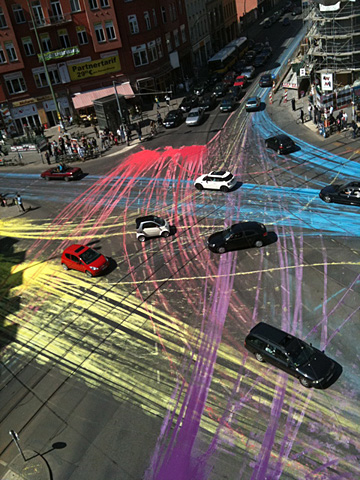
This reminded me that I recently discovered that Google Maps now includes traffic for Brussels. It was the case for Berlin since a long time and the Rosenthaler Platz looks quite quiet for the moment:
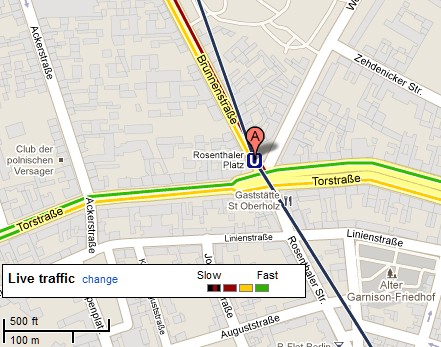
It’s not exactly the same colours 😉
(found via Olybop ; original page)

Although its presence in Belgium is more discreet than China or other European countries (for obvious reasons in the latter case), India has always something to show in Belgium. I decided to put some (most of?) events related to India in Belgium in a calendar so everyone can be aware of them. Here you are:
If you organize or know that something related to India in Belgium will happen, just let me know and I’ll add it to this calendar.
P.S. Although I post the information today (July16th, 2011), the calendar will continue to be updated even after tomorrow 😉
Photo credit: Nachda Sansaar Bhangra group at Bozar from myself 🙂 on Flickr
 Jean-Etienne's blog