Malaria is the 5th cause of death in low-income countries (according to WHO). That’s why I’m very happy to read that a malaria vaccine showed promising results in a phase 3 clinical trial (in The Guardian, The New York Times or Google News). As usual, I find very interesting to get all the information at the source: the original scientific paper was just published in The New England Journal of Medicine.
The main result of this study is that “the vaccine reduced malaria by half in [young] children […] during the 12 months after vaccination”. The study also showed that “the vaccine has the potential to have an important effect on the burden of malaria in young African children“. The conclusion of the article ends with “additional information on vaccine efficacy among young infants and the duration of protection will be critical to determining how this vaccine could be used most effectively to control malaria“.
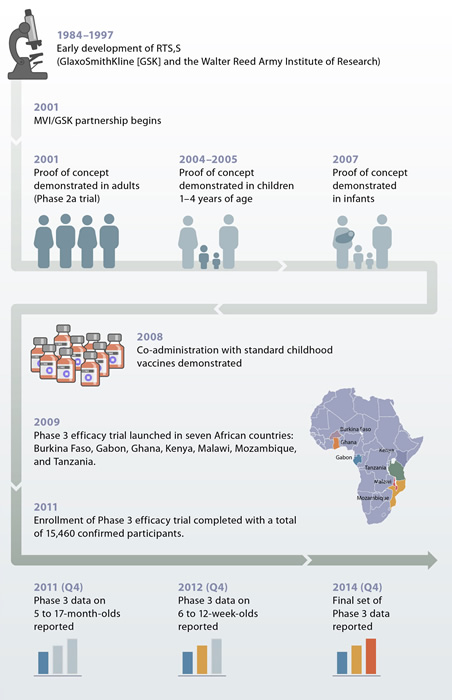
Indeed, as highlighted by the timeline reproduced below, the clinical trial isn’t over yet. Some data still needs to be reported (regarding younger children and duration of protection, as stated above).
If you want to follow what’s happening with this vaccine, the PATH Malaria Vaccine Initiative seeks “to accelerate the development of malaria vaccines and ensure their availability and accessibility in the developing world” and their website contains lots of useful information.
Disclaimer: I’m currently working for the pharmaceutical company that discovered and produced the RTS,S vaccine in this study. I’m however not part of the malaria team in any way. There is only publicly available information in this post.
On 14 December 1990, the United Nations General Assembly designated 1st of October the International Day of Older Persons. 1990 … it is already more than 20 years ago! People who signed the resolution at that time are now more than 20 years older. Some (most) of them probably are now considered as “old persons”. Do they still have the same view on elderly? Maybe the highlighted principles at that time (independence, participation, care, self-fulfilment, dignity, …) are too broad, too short, just enough?
So, already a century ago 😉 people were concerned by the dramatic changes in the composition of the world population. Thanks to progresses and greater availability of preventive measures and treatments more people are living longer and healthier. Even in countries where fertility rate is high, there will be less and less working-age adults per older adult. When you look at China, the percentage of people above 65 years old is projected to rise up to one fourth of the total population in only 40 years.
Actual and projected percentage of people above 65 in China (partial data from Leeder et al., Columbia University, 2005)
Imitating other countries like the USA, UK, the Netherlands, etc., Belgium recently launched its Open Data Initiative. Well, don’t expect fancy graphs nor any “web 2.0” widgets, it’s only a repository of data made available elsewhere. Most (if not all) data is provided “as it is”, in proprietary formats and not easily combined nor even visualized. So I welcome this initiative but just wish it will be at least maintained and updated or, better, grown into something better, just like other government open data websites. A dream will be to have at least direct data manipulation online, downloads in open formats, a clearly open license and why not an open API?
The Belgian population will continue to increase. The older population in Belgium will increase faster than the younger population. But seen like this, the growth will not be very dramatic.
Actual and projected percentage of people above 65 in Belgium (data from http://data.gov.be)
If we look at the projected percentage of people above 65 years old, we see that Belgium in 2010 is already at the same status as China in 2040. If experts say China will have an alarming percentage of old people in the future, the future is already here in Belgium! But it’s also true that Belgium took many decades to achieve this allowing some adaptations to take place. China will achieve it in only a few decades and will have to cope with these changes very quickly.
UN highlighted some challenges and ways to overcome them at a country / government level. The main issues will be to maintain older people as much as possible the same levels of health and independence as they enjoyed during their active lives.
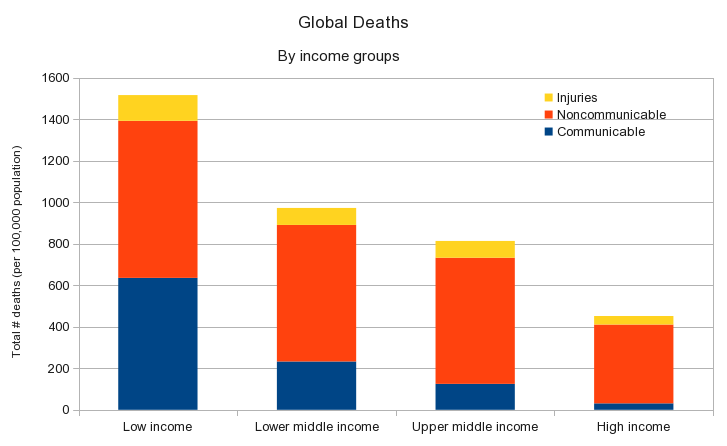
The Economist: non-communicable diseases account for the majority of deaths worldwide
I have nothing to add about the chart on the left (except I don’t think stacked bars are really useful to visually distinguish between quantities ; ok, I added something). My first reaction to the chart on the right was: these countries in the lower middle income group should really do something to tackle non communicable diseases: they represent more than the double amount of deaths than the total number of deaths in other income groups. Even for communicable diseases, they should do something: from the chart, it seems to be a bit less than 10m deaths from communicable diseases, i.e. approximately the same amount as the total number of deaths in other income groups too!
Just for you information (and because I also had to recall which countries were in that lower middle income group), here are some countries in the various groups (*):
Low income group: Afghanistan, Bangladesh, Ethiopia, North Korea, Nepal, Somalia, Togo, a.o.
Lower middle income group: Angola, Bolivia, Congo, Georgia, India, Iraq, Morocco, Pakistan, Sudan, Ukraine, Vietnam, a.o.
Upper middle income group: Algeria, Brazil, China, Cuba, Libya, Malaysia, Russian Federation, Serbia, South Africa, Thailand, a.o.
High income group: E.U. countries, Japan, Singapore, Switzerland, USA, a.o.
(*) Technically it follows the way the World bank classifies countries: economies are divided according to 2010 GNI per capita, calculated using the World Bank Atlas method. The groups are: low income, $1,005 or less; lower middle income, $1,006 – $3,975; upper middle income, $3,976 – $12,275; and high income, $12,276 or more.
Then you realize that if you just take the absolute number of deaths and compare these group of countries (as it’s done in the chart on the left), you don’t compare exactly on the same basis. What if some groups have more countries or lower/higher population? What if the total surface of countries in one group are much higher (lower) than in other groups? Idem for the population density, etc.
Fortunately, the WHO has a parameter one can use in order to objectivize a little bit this issue: the “Age-standardized mortality rate by cause (per 100 000 population)”. If you plot this parameter in the same way as above, you obtain this chart:
Age-standardized mortality rate by cause (per 100 000 population) per income group
From this you can now say that low income countries should really do something about NCDs but also communicable diseases, etc.
Presented like this, the number of deaths due to injuries and communicable diseases (per 100,000 pop.) decreases if the income of the country increases. In other word, more income you have, relatively less risk you have to die from injuries or communicable diseases. That explains why 1 death under a fallen wall is reported as a big sad news in Belgium while 60 deaths in a bus crash are not even reported in the news in India.
Another striking conclusion is that in low income countries there is approximately the same number of deaths (per 100,000 pop.) due to NCDs and due to communicable diseases (+/- 20%). We are all aware of tuberculosis, malaria, AIDS/HIV, etc. in less rich countries but it seems NCDs are an equally important issue.
But the most frightful conclusion from these numbers is that there is approximately the same number of deaths (per 100,000 pop.) due to NCDs in all income groups (674 ± 75) except the high income one. In other words, irrespective of you location or your income (except high income), you have the same chances to be affected by a non communicable disease. And irrespective on your income (and this time, even for high income countries), you have more chances to die from a non communicable disease than a communicable disease.
Last week, United Nations gathered in New York, USA, to talk about prevention and control of non-communicable diseases (NCDs). Non-communicable diseases are non-infectious, of long duration and generally progressing slowly. Due to the fact they are not infectious, there is no pathogen to target and there is no transmission medium to fight. Due to their long duration and slow progression, one usually notices NCDs when it’s too late and eradicating NCDs is less spectacular than other (not less important) infectious diseases. However WHO measured that NCDs represents more than 60% of all deaths in the world. For the occasion, WHO released an introductory video that summarize the issue.
So there are 4 main non-communicable diseases:
Cardiovascular diseases
Diabetes (both of them represent 70% of deaths by NCDs)
Cancers (~ 20% of deaths by NCDs)
Chronic respiratory diseases (~ 10% of deaths by NCDs)
NCDs are not directly in the UN Millenium Development Goals but I already mentioned they represent 4 of the top 5 killers in the USA. Two of them are also in the top 5 killers worldwide. If the Millenium Goals succeed, non-communicable diseases will be the next big issue in health.
Although NCDs were considered as a disease limited to high income countries (with infectious diseases affecting low income countries), this is not really the case anymore. For instance, the map of male deaths due to cardiovascular diseases and diabetes in 2008 shows an approximately uniform rate in high income countries with some higher rates in low income countries (especially on the African continent).
WHO World : Cardiovascular diseases and diabetes, death rates per 100 000 population, age standardized: Males, 2008
If nothing is done, the incidence of NCDs will increase. On top of being a health issue, a matter of life and death, it will also become an economical problem as the costs of treatment as well as the indirect costs will also dramatically increase (increase per case treated and increase due to the number of cases treated).
Incident cases and cost of diagnosed diabetes per 1,000 people (adapted from Boyle et al. 2010 and Alternative Futures Diabetes 2025)
If you are looking for more figures about the cost of non-communicable diseases, here are two detailed reports recently published:
In a nutshell, non-communicable diseases are everywhere and the future doesn’t look happy. However …
However risk factors are identified and many of them are related to our own lifestyle:
Physical inactivity
Unhealthy diet
Tobacco use
Harmful use of alcohol
To end on a positive note, all these risk factors can be easily controlled and for a limited additional cost. For instance, governments can protect people from tobacco (taxes as well as bans on tobacco advertising, promotion and sponsorship, …) and alcohol (access restriction, bans on advertising, …) as well as promote public awareness about diet and physical activity. Companies can also promote healthy diet and physical activities to their employees. On top of that, the food industry can also include relevant actions in their corporate social responsibility policies. Finally on a personal level, we can increase our physical activity, increase fruit and vegetable intake, reduce our use of tobacco and alcohol, etc. Simple, cheap actions ; huge interesting consequences.
I became recently interested in wearable electronics and wearable communication. I think we usually don’t need a computer at home. But I also think that electronics, sensory / storage / communication / helper devices will invade our world (privacy) at one point.
A few months ago, I liked Phillip Torrone’s retrospective collection of wearable electronic devices (for Make:). It will be quite fun to wear some of the stuff he showed. However most of the current applications shown are mostly designed to collect information from the body they are attached to or to communicate with this body. This is very much self-centered.
Recently (tonight), I watched Kate Hartman’s TED talk: The art of wearable communication. As the title implies, Kate Hartman goes one step further and designs wearable communication devices. I must admit I’m not sure I would want to wear the devices she designed. But I admire how simple these devices can be and yet some of them create an effective embryo of communication with others.
Kate Hartman and her wearable communication devices
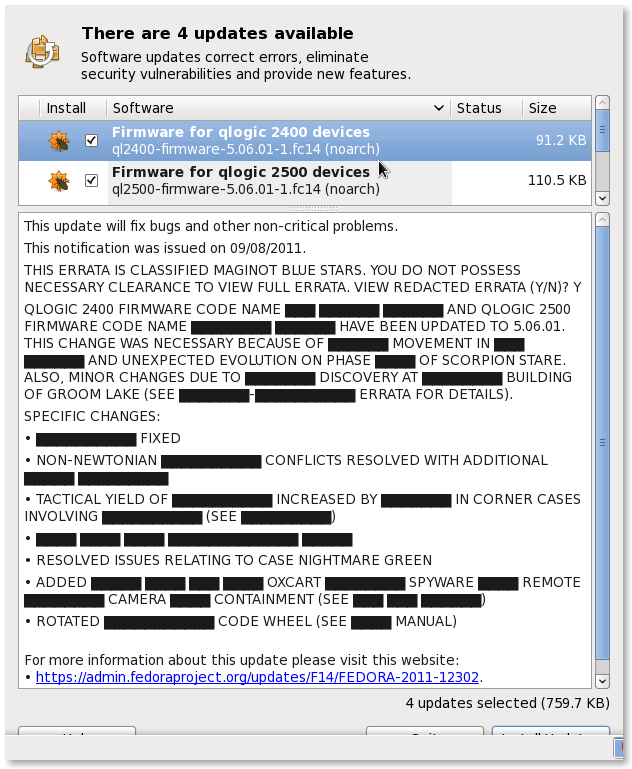
Although some people think it’s a joke (see kalev’s comment on 2011-09-17 19:13:44 in the bugfix report), I won’t install this update; I agree it’s funny but refusing to install it at least gives me the feeling I have still something to say on my system (that’s also what free software are for, isn’t it?).
I also like what the (same) submitter wrote for the first update:
Updated qlogic 2400 and 2500 firmware to 5.03.13. What does 5.03.13 do? No one knows, except for QLogic, and they’re not telling. I asked, and they told me that information was only available under NDA. So, I encourage you to imagine what this firmware does, and the bugs it fixes. While you’re at it, imagine a world where vendors release source code for their firmware.
Google+ (G+) is a social networking and identity service operated by Google. It started a few months ago like a closed service from where you can’t get out any data and where the only possible interaction (read/write/play) is only possible via the official interfaces (i.e. the web and android clients). Google promised to release a public API and it partly did so tonight, here.
As they stated, “this initial API release is focused on public data only — it lets you read information that people have shared publicly on Google+” (emphasis is mine). So you can already take most of your data out of G+ (note that it was already possible to download your G+ stream with Takeout from the Google Data Liberation Front). As usual, it’s a RESTful API with OAuth authorization. It comes with its own rules and terms (it could be interesting to add to GooDiff). The next step would be to be able to directly write something on Google+.
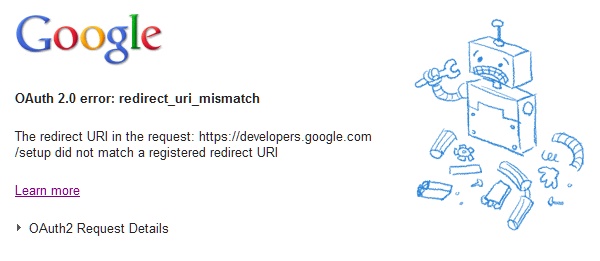
I only tried to try the examples so far. But unfortunately I got an authorization error. I won’t go further for tonight but their error screen is interesting 🙂
Reference Manager is a commercial reference management software package. It is extensively used in biomedical research, along with Endnote (sold by the same company), mainly because the main OS in these labs is Windows from Microsoft. I used it at the university and still have some reference databases in its format (with file extension .rmd).
This evening, I had to go back into one of those proprietary, closed databases I still had (most of my references were later re-entered in a BibTeX file). I could have borrowed my wife’s computer running Windows or tried some Open Source software that can open .rmd files. But it would have been too easy. So I tried it with Wine, a program that allows Microsoft Windows applications to run under Linux. In Wine AppDB, it is written people had tried version 9 and 11. In the old time, I bought a student license for version 10.
I’m running Fedora 14 and Wine 1.3.24. The installation didn’t cause any problem. Launching the application neither. I can easily open existing database and see the reference summary (bottom part of the screen, see screenshot below). But I can’t properly see the reference details (upper part of the screen). In fact, all the details are there but they are not properly rendered. If you click in one of these fields, you’ll see the text from these fields. But once you’ll click elsewhere, the previously clicked field will disappear. The search function in the database is working. The export of a bibliography list from a selection of references in the application works. I was not able to test the integration with MS-Word. Note that it cannot search in PubMed (but it’s probably due to the fact the update for PubMed was not installed).
Reference Manager running under Linux via Wine
I also submitted an entry in the Wine AppDB ; it is currently reviewed.
When I studied biology as well as when I did my Ph.D., our professors were always after us because of references. I think with their precious help we learnt the art of referencing: choosing good references, citing them at the appropriate location in a text and, of course, giving enough information at the bottom of the text to allow the reader to find these references.
I just finished reading two articles in a recent edition of The Economist and they reminded me how important are these references. These articles are What would Jesus hack? and Worrying about wireless.
First an aside: it might be an editorial choice but I would prefer to know who wrote an article rather than anonymity. I don’t have (and won’t have) anything personal against any author. I just like to know if I’m reading something written by a young Mr. I-know-everything with no background in the topic of the article or by a Mrs Specialist who appears to work in the field she’s writing about. In this blog, who I am is in the “About” section in the bar above.
The only point that the article might get right is that some software programmers are somehow seeing themselves and / or seen by others as gods: Richard Stallmann, Linus Torvalds, Bill Gates (god turned philanthropist), Steve Jobs (god turned designer), etc. On top of that, every programmer had her/his Eureka moment when she/he solves a bug after hours trying to fix the code. Otherwise, I agree with what the unnamed author puts in the mouth of Kevin Kelly and that I can summarize by: “with more power comes more responsibilities”.
And, as I pointed out in the beginning, there isn’t any reference at the bottom of the paper version, any link in the digital version. Statements and people in this article could have been 100% fictional, no one would have known that (until you look for them on the web).
I have the same issue with Worrying about wireless: no sources, no references. I don’t forbid the anonymous writer to have an opinion on the topic. Just let the others also make their own opinion by citing the sources you are using. This article is just shaping the opinion of readers in a hurry by using a partisan language and not citing sources. Even when indirectly citing sources (e.g. the WHO IARC classification), the anonymous coward succeeds in using negative wording to dismiss what doesn’t please his / her theory. I would have liked to have more information about the potential adverse effects of wifi waves in the long run, for instance. But I will unfortunately not believe such one-way gibberish.
Now you’ll tell me I don’t have to read The Economist and you’ll be right 🙂
This well-known French proverb is similar to: “pride comes before a fall”.
This evening I was told by the newly installed version of Firefox that my Flash player was outdated. Firefox provides a simple link to download that Flash Player. I save the installer (install_flashplayer10_mssd_aih.exe) in a directory where I save all my downloads before sorting them. I launch the installer. It moves itself to my system temporary directory and launches itself again. First I find it very rude from the installer to move itself anywhere on my disk. Then now, since 15 minutes it’s stuck at the step where it tries “retrieving install”.
Adobe Flash, if you want to play tricks, do it cleverly! Now your installation is stuck and cannot download the remaining part of the installer because it should use a proxy. This is a known issue, of course. And the simple and most obvious solution is that you can download the true, full Flash player installer here. Why not provide this link immediately?









 Jean-Etienne's blog