Category: My life

Belgian eavesdropping increased in 2009

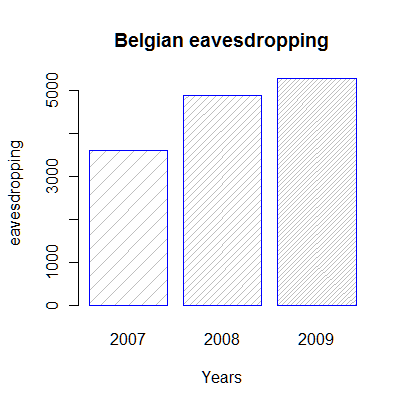
Following this article (French), official phone eavesdroppings again increased in Belgium in 2009: Belgian police listened 5265 times to private conversations. The French transcript is here.

Evolution of the number of official eavesdropping in Belgium

One doesn’t get much more than these numbers: nothing about the number of hours spent listening, nothing about the percentage of effectiveness/results, nothing about internet eavesdropping (e-mail e.g.). One thing struck me: all requests for eavesdropping were accepted. Or, at least that what the Minister implied when he wrote “there is no distinction between the number of requests and the number of effective eavesdropping”.

Volcano and CO2 (bis)

Well, now I understand a bit better why experts said the small fall in carbon emissions indirectly due to the volcano is unlikely to have any significant impact on climate (see previous post) … InformationIsBeautiful made a correction following comments and the difference in CO2 emission is smaller:

Comparison of C02 emission by InformationIsBeautiful

However, although the air traffic is to slowly come back to normal, we can still enjoy some very nice moment without any plane in the sky:

Still no plane by jepoirrier on Flickr

Volcano and CO2

One side-effect of the eruption of the Eyjafjallajoekull volcano is that there is no more plane in the European sky for the last few days. On one side, people are obliged to stay longer on holidays, others can’t make business trips, some food and other items can’t be transported, plane companies are crying but train and coach ones are more than happy. The last week-end was sunny and a lot of people enjoyed going outside in North Europe.

Lavender Ash Cloud from tj.blackwell on Flickr

This morning, stuck in a traffic jam, I was wondering what is the amount of CO2 emissions saved by forcing planes to stay on the ground. And I found this great illustration from Information Is Beautiful:

planes or volcanos from InformationIsBeautiful

So, visually, forcing planes to stay on the ground has an impact. But experts says although this has caused a small fall in carbon emissions, it is unlikely to have any significant impact on climate (cited by The Guardian). I don’t really know who these experts are. I guess the newspaper wants us to believe what it wrotes as is. But continuing reading about the subject, one learns that although the industry seems to take the pollution aspect of flights into consideration, we are far from perfection.

Finally, what I like the most in this illustration, it’s that it’s backed by real data (see at the bottom of the cited post). BlueSkyModel.org also has some data on how to compute a flight carbon footprint.

Credits:
First illustration: Lavender Ash Cloud from tj.blackwell on Flickr
Second illustration: Planes or volcanos from InformationIsBeautiful.

Every year the same?

Every year, same resolutions. And same end? As I did previous years, I promised to myself to update this blog more often but it seems “daily life” events caught me up.

This year, I resigned from my position at Callataÿ & Wouters (C&W). A lot can be said and written but overall, it was an interesting experience. I’ve learned a lot about software development and how to manage people (or not). Finally, I’ve met some very interesting people. Let’s close this chapter now.

Open space office


This year, I finally finished my Ph.D. thesis! The public defense will be on March 24th, 2010 in Liege (Roskam lecture hall). I’ll talk about rat hippocampus, proteins, stress, sleep (deprivation) and cognition. The final text will be available here after that.

And finally, I’m joining GSK biologicals. This is a new challenge but, from what I’ve seen so far, I think I’ll enjoy it a lot!

So I hope to resume posting more frequently on this blog (and with stuff more interesting than my own personal life) 🙂 Stay tuned!

Ignite presentation style

Being away from presentations to my dismay since a few months, I always enjoy reading the Presentation Zen blog, Garr Reynold’s blog on issues related to presentation design.

Recently, Garr came back on the Ignite presentation style with a presentation from Pamela Slim. Here is a video recording:

I maybe liked this presentation for its content but above all for its style … At Ignite, you can have a maximum of 20 slides that automatically advance every 15 seconds (so max. 5 minutes talk). I like this kind of challenge. Unfortunately, there is no planned Ignite event in Western Europe soon where I would be able to watch this live.

Finally, I still have to find a way to use this kind of presentation (large images, few words) in a scientific communication (who said PhD dissertation?) where precise facts and figures are often more important than concepts or message. Maybe just because scientific presentations are often meant to share measures, quantitative observations, statistical data, etc. For a communication that will show a review of the literature on a subject, this style would fit better.

Implication of Oracle buying Sun on Open Source projects?

Oracle and Sun announced a few days ago that Oracle will buy Sun. Others are more apt than me to comment on the financial and strategic impacts of this move (for example, in the Guardian, the New York Times, the Wall Street Journal or on Slashdot). I’m more interested in the potential implications this move could have on some Open Source projects which were backed by Sun. I indeed believe Oracle will continue the development of his contributions to Open Source software, whether they are notable (Btrfs or Oracle Enterprise Linux) or less visible.

In the last few years, Sun opened or started to open some of its (key) software like OpenOffice.org, Netbeans, OpenSolaris, Java, … Sometimes these moves were considered as a last hope to see them used (and developed) at a lower cost for Sun. Very often, these moves were criticised because the “opening” was only partial (non-free licenses, stranglehold on the development processes, …) or just announced (Java still needs to be fully opened). However, the openings of OpenOffice.org and Netbeans can be seen as successes: OpenOffice.org is a more and more used office suite and Netbeans fairly competes with another open development source-editor-cum-development-platform, Eclipse. In the beginning of 2008, Sun acquired MySQL AB, the company behind the probably most used database system for website development, MySQL. Unfortunately, rumors spread that Sun will close some of the MySQL features, leading to forks like Maria(DB) (rumors where later dismissed). Anyway, these software are (nearly) free. But they may not be in Oracle strategic plannings.

Oracle now owns 2 database management systems: Oracle and MySQL. Although they maybe do not compete at the same level and although I don’t see Oracle dumping one RDBMS (because of their respective user base), it could become expensive to maintain 2 code bases for the same goal.

Oracle now owns 2 operating systems too: Oracle Enterprise Linux and (Open)Solaris. And here, they compete at the same level: on enterprise desktops and servers. The beauty of Open Source is that OpenSolaris may survive thanks to its community if it would be abandoned by Oracle.

Oracle has now the lead on the development of an IDE, Netbeans, while it extensively uses and promotes its rival, Eclipse. Fortunately for Netbeans, it has a strong community behind … I guess it’s approximately the same for Sun virtualisation software, VirtualBox (no immediate use for Oracle) but I’m not really following these technologies so I won’t bet anything on this.

Oracle now also has the lead on the development of Java, a programming language cherished by a lot of companies around the world (some say Java is the COBOL of the 1990s …). Oracle also uses Java for its tools so I guess Oracle will continue its development. Whether the opening of Java will continue and if it does, at what speed, one can assume it will depend on the financial and/or fame benefits Oracle can gain from it.

Oracle owns now an office suite. I don’t really see how it fits into Oracle software portfolio unless Oracle really pushes hard its adoption in companies where Microsoft Office has a monopoly. Or Oracle intends to beat Microsoft by offering a complete solution, from corporate servers (with Oracle DB, Enterprise Linux, BEA/Tomcat application servers and Sun hardware) to corporate desktops (with OpenSolaris (?) and OpenOffice.org), Oracle’s CEO Larry Ellison being known to forecast the end of Microsoft. By providing top-to-toe-solutions, this would make Oracle the next IBM but this is another subject.

So, except for Java (and maybe OpenOffice.org), I’m rather pessimistic on the future of these Open Source / free software projects. Does this mean that they will not survive? I don’t think so. They users/fans base is sometimes huge. And similar high-quality Open/Free projects live very well without one big corporation behind them ; think of PostgreSQL, Linux, Eclipse, Python/Ruby, etc.

Ryan Paul wrote an article in ArsTechnica on the same topic, for those who are interested.
March 25th, 2009: Document Freedom Day

This 25th of March, 2009 is Document Freedom Day. Although it’s not as important as starvation in parts of the world, the economic crisis or the continuous deterioration of our privacy and civil rights (in UK and elsewhere), it’s good to take a break and think about our use of electronic documents in our everyday live. Let me just give you an example …

A few days ago, I was trying to retrieve data from an experiment. As a well-formatted student, I stored my data in a then state-of-the-art, proprietary statistical software my dear statistical professor taught me to use. As long as I had this software, it was fine. Now that my university stopped to pay the license, that I didn’t installed this software on my new computer, I am stuck with a serie of 1, 0 and other delirious characters in that file. Does that mean I lost all my data? Yes.

Fortunately, I thought to save a backup of my data in a simple text file with CSV format. This saved my day because although I don’t have more information in this file, I don’t have less information than in the proprietary format either. And this simple CSV format allows me to enjoy processing my data with any spreadsheet software I want along with some more serious statistical packages like R.

What is open? by Paul Jacobson

If you want to know more about Open Documents (and more broadly about Open Standards), you can start by reading what are Open Standards. Wikipedia has a more technical article about them.

Photo credit: Slide0001 by Paul Jacobson on Flickr (licence by-nc-sa)

Welcome again!

Hi, and welcome back on my blog.

Following the progressive migration from epot.org to jepoirrier.net, you landed on the new address for my blog: http://www.jepoirrier.net/blog (new RSS feed here).

The migration process was easy, thanks to the WordPress eXtended RSS that contains posts, pages, comments, custom fields, categories, and tags. But there are two things left I wanted to keep: existing users and images which links are hard-coded in various posts.

For the links to images, I just replaced the old URL by the new one in VIM: :%s/old_path/new_path/g and voilà!

For the existing users, I just exported data from tables wp_users and wp_usermeta. So if you had an account on my previous blog (mandatory to post comments), you can use the same login and password! 🙂

Building on the move, I also changed links to more “sexy” permalink and allowed Gravatar for all comments (if you don’t have a gravatar, an identicon will be automatically generated for you).

One more thing to do: an automated redirection from the old pages/RSS to this one. I guess it would take the form of a HTTP 301 Redirection but I have still to automate the transformation of the 272 URLs …

See you here for the next post!

Photo credit: “We’ve moved” by Brian Gurrola on Flickr (CC-by-sa).