Category: Lab life

Yesterday was International Day of Older Persons

On 14 December 1990, the United Nations General Assembly designated 1st of October the International Day of Older Persons. 1990 … it is already more than 20 years ago! People who signed the resolution at that time are now more than 20 years older. Some (most) of them probably are now considered as “old persons”. Do they still have the same view on elderly? Maybe the highlighted principles at that time (independence, participation, care, self-fulfilment, dignity, …) are too broad, too short, just enough?

So, already a century ago 😉 people were concerned by the dramatic changes in the composition of the world population. Thanks to progresses and greater availability of preventive measures and treatments more people are living longer and healthier. Even in countries where fertility rate is high, there will be less and less working-age adults per older adult. When you look at China, the percentage of people above 65 years old is projected to rise up to one fourth of the total population in only 40 years.

Actual and projected percentage of people above 65 in China
Actual and projected percentage of people above 65 in China (partial data from Leeder et al., Columbia University, 2005)

Imitating other countries like the USA, UK, the Netherlands, etc., Belgium recently launched its Open Data Initiative. Well, don’t expect fancy graphs nor any “web 2.0” widgets, it’s only a repository of data made available elsewhere. Most (if not all) data is provided “as it is”, in proprietary formats and not easily combined nor even visualized. So I welcome this initiative but just wish it will be at least maintained and updated or, better, grown into something better, just like other government open data websites. A dream will be to have at least direct data manipulation online, downloads in open formats, a clearly open license and why not an open API?

So, what about the elderly in Belgium? There is a section about population forecast by age (which comes from the economy ministry in Excel format).

Projected aging of population in Belgium
Projected aging of population in Belgium (data from http://data.gov.be)

The Belgian population will continue to increase. The older population in Belgium will increase faster than the younger population. But seen like this, the growth will not be very dramatic.

Actual and projected percentage of people above 65 in Belgium (data from http://data.gov.be)

If we look at the projected percentage of people above 65 years old, we see that Belgium in 2010 is already at the same status as China in 2040. If experts say China will have an alarming percentage of old people in the future, the future is already here in Belgium! But it’s also true that Belgium took many decades to achieve this allowing some adaptations to take place. China will achieve it in only a few decades and will have to cope with these changes very quickly.

UN highlighted some challenges and ways to overcome them at a country / government level. The main issues will be to maintain older people as much as possible the same levels of health and independence as they enjoyed during their active lives.

N.B. For other sources of data in Belgium, one may be interested in visiting the Bureau fédéral du Plan, Statistics Belgium and the Statistics section of the National Bank of Belgium.

NCDs account for the majority of deaths worldwide

A few days before my last post and still about the UN High Level Meeting on Prevention and Control of Non-communicable Diseases, The Economist issued a daily chart showing that non-communicable diseases (NCDs) account for the majority of deaths worldwide. I copy the chart below:

The Economist: non-communicable diseases account for the majority of deaths worldwide

I have nothing to add about the chart on the left (except I don’t think stacked bars are really useful to visually distinguish between quantities ; ok, I added something). My first reaction to the chart on the right was: these countries in the lower middle income group should really do something to tackle non communicable diseases: they represent more than the double amount of deaths than the total number of deaths in other income groups. Even for communicable diseases, they should do something: from the chart, it seems to be a bit less than 10m deaths from communicable diseases, i.e. approximately the same amount as the total number of deaths in other income groups too!

Just for you information (and because I also had to recall which countries were in that lower middle income group), here are some countries in the various groups (*):

  • Low income group: Afghanistan, Bangladesh, Ethiopia, North Korea, Nepal, Somalia, Togo, a.o.
  • Lower middle income group: Angola, Bolivia, Congo, Georgia, India, Iraq, Morocco, Pakistan, Sudan, Ukraine, Vietnam, a.o.
  • Upper middle income group: Algeria, Brazil, China, Cuba, Libya, Malaysia, Russian Federation, Serbia, South Africa, Thailand, a.o.
  • High income group: E.U. countries, Japan, Singapore, Switzerland, USA, a.o.

(*) Technically it follows the way the World bank classifies countries: economies are divided according to 2010 GNI per capita, calculated using the World Bank Atlas method. The groups are: low income, $1,005 or less; lower middle income, $1,006 – $3,975; upper middle income, $3,976 – $12,275; and high income, $12,276 or more.

Then you realize that if you just take the absolute number of deaths and compare these group of countries (as it’s done in the chart on the left), you don’t compare exactly on the same basis. What if some groups have more countries or lower/higher population? What if the total surface of countries in one group are much higher (lower) than in other groups? Idem for the population density, etc.

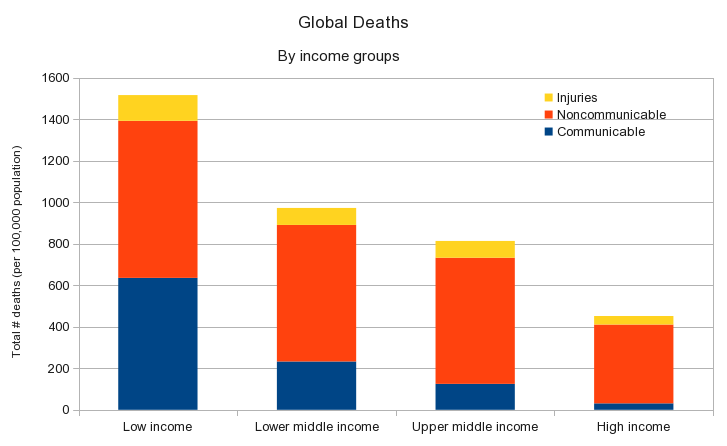
Fortunately, the WHO has a parameter one can use in order to objectivize a little bit this issue: the “Age-standardized mortality rate by cause (per 100 000 population)”. If you plot this parameter in the same way as above, you obtain this chart:

Age-standardized mortality rate by cause (per 100 000 population) per income group

From this you can now say that low income countries should really do something about NCDs but also communicable diseases, etc.

Presented like this, the number of deaths due to injuries and communicable diseases (per 100,000 pop.) decreases if the income of the country increases. In other word, more income you have, relatively less risk you have to die from injuries or communicable diseases. That explains why 1 death under a fallen wall is reported as a big sad news in Belgium while 60 deaths in a bus crash are not even reported in the news in India.

Another striking conclusion is that in low income countries there is approximately the same number of deaths (per 100,000 pop.) due to NCDs and due to communicable diseases (+/- 20%). We are all aware of tuberculosis, malaria, AIDS/HIV, etc. in less rich countries but it seems NCDs are an equally important issue.

But the most frightful conclusion from these numbers is that there is approximately the same number of deaths (per 100,000 pop.) due to NCDs in all income groups (674 ± 75) except the high income one. In other words, irrespective of you location or your income (except high income), you have the same chances to be affected by a non communicable disease. And irrespective on your income (and this time, even for high income countries), you have more chances to die from a non communicable disease than a communicable disease.

Ways to mitigate risk factors for NCDs (end of previous post) are still on.

N.B. WHO numbers are from 2008 for both charts.

The state of non communicable diseases

Last week, United Nations gathered in New York, USA, to talk about prevention and control of non-communicable diseases (NCDs). Non-communicable diseases are non-infectious, of long duration and generally progressing slowly. Due to the fact they are not infectious, there is no pathogen to target and there is no transmission medium to fight. Due to their long duration and slow progression, one usually notices NCDs when it’s too late and eradicating NCDs is less spectacular than other (not less important) infectious diseases. However WHO measured that NCDs represents more than 60% of all deaths in the world. For the occasion, WHO released an introductory video that summarize the issue.

So there are 4 main non-communicable diseases:

  1. Cardiovascular diseases
  2. Diabetes (both of them represent 70% of deaths by NCDs)
  3. Cancers (~ 20% of deaths by NCDs)
  4. Chronic respiratory diseases (~ 10% of deaths by NCDs)

NCDs are not directly in the UN Millenium Development Goals but I already mentioned they represent 4 of the top 5 killers in the USA. Two of them are also in the top 5 killers worldwide. If the Millenium Goals succeed, non-communicable diseases will be the next big issue in health.

Although NCDs were considered as a disease limited to high income countries (with infectious diseases affecting low income countries), this is not really the case anymore. For instance, the map of male deaths due to cardiovascular diseases and diabetes in 2008 shows an approximately uniform rate in high income countries with some higher rates in low income countries (especially on the African continent).

World : Cardiovascular diseases and diabetes, death rates per 100 000 population, age standardized: Males, 2008
WHO World : Cardiovascular diseases and diabetes, death rates per 100 000 population, age standardized: Males, 2008

If you are looking for more numbers, visit the WHO Global Health Observatory on Noncommunicable diseases.

If nothing is done, the incidence of NCDs will increase. On top of being a health issue, a matter of life and death, it will also become an economical problem as the costs of treatment as well as the indirect costs will also dramatically increase (increase per case treated and increase due to the number of cases treated).

Incident cases and cost of diagnosed diabetes per 1,000 people
Incident cases and cost of diagnosed diabetes per 1,000 people (adapted from Boyle et al. 2010 and Alternative Futures Diabetes 2025)

If you are looking for more figures about the cost of non-communicable diseases, here are two detailed reports recently published:

In a nutshell, non-communicable diseases are everywhere and the future doesn’t look happy. However …

However risk factors are identified and many of them are related to our own lifestyle:

  • Physical inactivity
  • Unhealthy diet
  • Tobacco use
  • Harmful use of alcohol

To end on a positive note, all these risk factors can be easily controlled and for a limited additional cost. For instance, governments can protect people from tobacco (taxes as well as bans on tobacco advertising, promotion and sponsorship, …) and alcohol (access restriction, bans on advertising, …) as well as promote public awareness about diet and physical activity. Companies can also promote healthy diet and physical activities to their employees. On top of that, the food industry can also include relevant actions in their corporate social responsibility policies. Finally on a personal level, we can increase our physical activity, increase fruit and vegetable intake, reduce our use of tobacco and alcohol, etc. Simple, cheap actions ; huge interesting consequences.

Reference Manager 10 with Wine

Reference Manager is a commercial reference management software package. It is extensively used in biomedical research, along with Endnote (sold by the same company), mainly because the main OS in these labs is Windows from Microsoft. I used it at the university and still have some reference databases in its format (with file extension .rmd).

This evening, I had to go back into one of those proprietary, closed databases I still had (most of my references were later re-entered in a BibTeX file). I could have borrowed my wife’s computer running Windows or tried some Open Source software that can open .rmd files. But it would have been too easy. So I tried it with Wine, a program that allows Microsoft Windows applications to run under Linux. In Wine AppDB, it is written people had tried version 9 and 11. In the old time, I bought a student license for version 10.

I’m running Fedora 14 and Wine 1.3.24. The installation didn’t cause any problem. Launching the application neither. I can easily open existing database and see the reference summary (bottom part of the screen, see screenshot below). But I can’t properly see the reference details (upper part of the screen). In fact, all the details are there but they are not properly rendered. If you click in one of these fields, you’ll see the text from these fields. But once you’ll click elsewhere, the previously clicked field will disappear. The search function in the database is working. The export of a bibliography list from a selection of references in the application works. I was not able to test the integration with MS-Word. Note that it cannot search in PubMed (but it’s probably due to the fact the update for PubMed was not installed).

Screenshot of Reference Manager under Linux via Wine
Reference Manager running under Linux via Wine

I also submitted an entry in the Wine AppDB ; it is currently reviewed.

An update on JoVE

Sorry We're Closed by bluecinderella on FlickrThree years ago, I wrote about JoVE, the Journal of Visualized Experiments. JoVE was a peer reviewed, open access, online journal devoted to the publication of biological research in a video format. I recently discovered that since 2009, JoVE is now just a peer reviewed, open access, online journal devoted to the publication of biological research in a video format. You can debate at length on whether JoVE was Open Access (as I thought) or not. I just think it’s sad although I understand their motives: in a recent exchange with them, they wrote they “handle most production of our content [themselves] and it is a very very costly operation”.

The recent exchange I had with Jove was about another previous post describing a way to store the videos locally, as anyone would do with Open Access articles in PDF format. I was unaware of two things:

  1. JoVE dropped the “Open Access” wording as I wrote above (however, there is still a possibility to publish a video in free access for a higher fee, as described as “Open access” in the About section for authors);
  2. the “trick” was still working (and people at JoVE seemed to be aware of that and I saw similar description of the trick elsewhere).

Unfortunately, this trick will not work anymore in the coming weeks since they will “do token authentication with [their] CDN“. JoVE will remain for me a very interesting journal with videos of quality and without any equivalent yet (SciVee doesn’t play in the same playground and I wonder why Research Explainer missed the comparison in their 2010 interview).

I was then wondering what could have been the impact of this decision on the number of videos published in JoVE as free access. I didn’t find any statistics related to this on the JoVE website (unrelated thought: I like the way BioMed Central gives access to its whole corpus). I then relied on PubMed to find all the indexed articles from JoVE and relied on its classification of “Free Full Text” (i.e. copied on the PubMed Central website, including the video). At the time of writing (August 2011), on a total of 1191 indexed articles, 404 are “Free Full Text”. This is nearly 34% of all JoVE articles. When you split this by year since 2006 (when JoVE went online), you obtain the following table and chart:

Year All articles Free Full Text articles Note
2006 18 18 Full free access
2007 127 127 Full free access
2008 115 87
2009 217 118 Introduction of Closed Access
2010 358 42
2011 356 12 So far (August 2011)
2011 534 18 Extrapolation to full year keeping the same proportion

Total number of articles and free full texts in JoVE

As we can see on the left chart, plotting the total number of articles in JoVE -vs- time, there is a steady increase in the number of articles since 2006. This tend to prove that more and more scientists enjoy publishing videos. It would be nice to have access to JoVE statistics in order to see if there is the same increase in the overall number of views of all videos. With “web 2.0” and broadband access in universities, I guess we would see this increase.

However, as we can see on the right chart, plotting the percentage of JoVE “Free Full Texts” in PubMed -vs- time, there is a dramatic decrease in the percentage of Free Full Texts in JoVE since 2008-2009. Less and less videos are published and available for free in PubMed Central. This is unfortunate for the reader without subscription. This may also be unfortunate for the publisher since there are less and less authors over time who pay the premium for free access. But since authors also pays for closed access, there is certainly a financial equilibrium.

Some methodological caveats … The PMC Free Full Texts are not necessarily in free access on the JoVE website (and vice-versa ; all the ones I checked are but I didn’t check all of them!). This might explain why there is already a reduction in Free Full Texts in PMC in 2008 while JoVE closed their journal in April 2009. I expected the same proportion of free articles published until the end of 2011 than in the beginning of 2011 ; this might not be the case (let’s see in January 2012 ; this also leads to the question: “is there a seasonal trend in publishing in JoVE?”).

What I take as a (obvious) message is that if authors can pay less for the same publication, they will, regardless of how accessible and affordable the publication will be for the reader. I don’t blame anyone. But I can’t help thinking the Open Access model is better for the universal access to knowledge.

Photo credit: Sorry We’re Closed by Cinderella on Flickr (CC-by-nc-sa)

OS need an immune system and not a CDC-like

In an IT World article, Tom Henderson gives many details about a US-government-led CDC-like organisation to fight malware. In summary, he states that companies and consultants providing security and prevention around operating systems don’t have any real motivation to eradicate malware. And in case of an “outbreak” of these malware, he added one needs a US government body to look after every computer “health”, coordinate the surveillance and the response. He even pushes the comparison with the human medical system by introducing a Hippocratic Oath for computer healthcare.

With all the respect I have for someone I’ve never heard of before, I think Tom Henderson misses one crucial point that make his flight of lyricism totally irrelevant. The missed point is that human beings (as well as every animal species and especially vertebrates) have a immune system. It’s our immune system that gives the first answer to any external “invasion”, it’s our immune system that can adapt to the diversity of threats out there, it’s our immune system that allow our body to recover.

Today computers have a nice body, nice mechanics. Operating systems are behaving like we tell them, not as separate entities. We constantly add foreign bodies (software) and they are constantly in contact with potential external aggressions (via file exchanges, media insertion, network connections). What we begin to give them are sentinels monitoring critical parts of the system, a kind of basic neural system. We invented the body-in-the-body (virtualization) to prevent one failing organ (software) to contaminate the remaining parts of the body (a.o.). We also give some vitamins (firewalls e.g.), strengthening  some defences. And finally we think that “anti-virus software” are enough while it’s only some kind of very basic, un-natural innate immune system.

Before thinking of a CDC-like body for our computers security, one should maybe think of adding a immune system to our computers. At least a basic one, where there is a response even to currently unknown threats. Then we might think of something more sophisticated, with memory and specific response. Look, there was no network, no communication outside: the body/computer can easily cope with the threat by itself. Research is already looking at such applications. And, yes, finally, if you insist, bring your CDC-like organism.

Aaron Swartz versus JSTOR

Boston Wiki Meetup Aaron Swartz, a 24-year old hacker, was recently indicted on data theft charges for downloading over 4 million documents from JSTOR, a US-based online system for archiving academic journals. Mainstream media (Reuters, Guardian, NYT, Time, …) reported this with a mix of facts and fiction. I guess that the recent attacks of hacking groups on well-known websites and the release of data they stole on the internet gave to this story some spice.

First, I really appreciate what Aaron Swartz did and is currently doing. From The Open Library, web.py, RSS, to the Guerilla Open Access Manifesto and Demand Progress, he brought a lot to the computer world and the awareness of knowledge distribution.

Other blogs around the world are already talking about that and sometimes standing up for him. I especially liked The Economics of JSTOR (John Levin), The difference between Google and Aaron Swartz (Kevin Webb) and Careless language and poor analogies (Kevin Smith). I also encourage you to show your support for Aaron as I think he’s only the scapegoat for a bigger process …

I also think Aaron Swartz went too fast. If you do the maths (see appendix below), the download speed was approximately 49Mb per second. Even in a crowded network as the MIT one, this continuous amount of traffic coming from a single computer (or a few if you forge your addresses) is easily spotted. I understand he might have been in a hurry given that his access was not fully legal (although I think it initially was). It was the best thing to do if he wanted to collect a maximum amount of files in the shortest period of time.

This lead me to wonder what was the goal behind this act.

People stated it was his second attempt at downloading large amounts of data (which is not exactly true), depicting him like a serial perpetrator. Others stated that his motives were purely academic (text-mining research, JSTOR Data For Research being somewhat limited). One can also think of an act similar to Anonymous or LulzSec that were in the press recently. Or money, maybe (4*10^6 articles at an average of $15 per article makes $60 million), although this seems highly unlikely. The simple application of his Guerrilla Open Access Manifesto?

What is also puzzling me is the goal of JSTOR. It constantly repeats that it is supporting scholarly work and access to knowledge around the world. From its news statement, it says it was not its fault to prosecute Aaron Swartz but US Attorney’s Office’s. But at the same time, they assure they secured “the content” and made sure it will not be distributed. And the indictment doesn’t contain anything related to intellectual property theft. The only portion related to the content is a fraudulent access to “things of value”.

I think one of the issue JSTOR has is that it doesn’t actually own the material it sells to scientists. The actual publishers are dictating what JSTOR can digitize and what it can’t. And unfortunately, they only see these papers as “things of monetary value”.

However these things are actual scientific knowledge, usually from a distant past and usually without any copyright anymore. Except the cost of digitizing and building the search engine database (which are both  provided by Google Books and Google Scholar for free, or the Gutenberg project in another area), all the costs related to the dissemination of these papers are already covered, usually since a long time. The irony is that some of the papers behind the JSTOR paywall are sometimes even freely available elsewhere (at institutions’ and societies’ repositories, e.g.).

It wouldn’t have cost much to put all these articles under an Open Access license while transferring them to JSTOR. JSTOR would then charge for the actual digitizing work but wouldn’t have to “secure the content” in case of redistribution since it would then be allowed. The not–for–profit service provided by JSTOR would then benefit to the knowledge instead of being one additional roadblock to it.

JSTOR, don’t become the RIAA or the MPAA of old scholar content!

Appendix. The maths

In “retaliation”, Gregory Maxwell posted 32Gb of data containing 18,592 JSTOR articles on the internet. This is an average of 1.762Mb per JSTOR article. Aaron Swartz downloaded 4*10^6 articles from JSTOR that represents approximately 6.723Tb of data. That took him 4 days (September 25th, 26th and October 8th and 9th, 2010) at an average of 1,721.17Gb per day. If we assume the computer was working 10 hours per day (he has to plug and unplug the computer during working hours), the average download speed id 172Gb per hour or 2.869Gb per minute or 48.958Mb per second.

Photo credit: Boston Wiki Meetup by Sage Ross on Flickr (CC-by-sa).

Today is World Population Day

Today, 11th of July 2011, is World Population Day. For that occasion, and as the world population is expected to surpass 7 billion this year, the UNFPA is launching a new campaign: 7 billion people – 7 billion actions.

7 billion actions poster - UNFPA

They highlight 7 key issues to explore:

  1. Poverty and inequality: reducing poverty and inequality also slows population growth.
  2. Women and girls: unleashing the power of women and girls will accelerate progress on all fronts.
  3. Young people: energetic and open to new technologies, history’s largest and most interconnected population of young people is transforming global politics and culture.
  4. Reproductive health and rights: ensuring that every child is wanted and every childbirth safe leads to smaller and stronger families.
  5. Environment: all 7 billion of us, and those who will follow, depend on the health of our planet.
  6. Ageing: lower fertility and longer lives add up to a new challenge worldwide: providing for aging populations.
  7. Urbanization: the next two billion people will live in cities, so we need to plan for them now.

These issues are not new. They are not even original: most bodies or meetings looking at issues for the future have approximately the same issues. But at least it’s another initiative to raise awareness, to think about them. And, most importantly, to act to tackle them.

I don’t think it’s wishful thinking to write that everyone can help. Besides being in the introduction brochure, teaching a child to read, planting a tree, visiting a senior, finding a cure, standing up for others and making someone smile are all simple actions we can do (even if we can’t do all of them, we can do some of them). We can start with our own kids, our own family, our own environment.

What will be your unique story?

Sometimes people are really stupid

I just read that orange agent is used in Brazil to clear the Amazon. I am not judging people who may be forced by their living conditions to do this (although I doubt people who did this are poor since they sprayed it by plane). It may be the cheapest way to clear a forest to use the land for pasture (although I doubt buying chemical and spraying it by plane is cheap). But …

Agent OrangeBut this is already very stupid because since at least the Vietnam war, we know that the orange agent is a very toxic product with detrimental effects on human health (in the USA, the Veterans Affairs are busy with that). On top of already using the orange agent to clear forests for mining, these guys thinks it will be interesting to go there and take care of the livestock. They will of course quickly earn money from selling meat from animals that grew there. But they will face health issues, at some point, for them and most probably for people who will eat that meat.

Because that’s the second stupid thing they are making: cows, horses, goats, sheep, etc. that will graze there will also be contaminated. In the worst case (for them), their meat will immediately be unfit for human. In the worst case (for everybody), the meat will be sold to people outside contaminated zones and these people will also be contaminated …

I will not be surprised if I read news about baby malformations in the coming years in Brazil. And I’m wondering why Monsanto is still selling orange agent anywhere in the world. Is money so important compared to human health?

Photo credit: Agent Orange by Emilio Labrador on Flickr (CC-by)

The Top 5 Killers of Men

From Delicious, I saw that Yahoo had an article about the top 5 killers of men. I thought it would be nice to see from where they get there data.

First, I have to mention that the article is really about American men, nothing else (not about mankind, not about men around the world, not about women, children, etc.). The article is related to the US National Men’s Health Week (the US National Women’s Health Week was in May 8-14, 2011). Although the article is giving advices, there are no sources of information.

However, it’s rather easy to obtain these numbers …

For the US, the CDC FastStats website is a hub to data about health in the US. Here is the CDC ranking for the top 5 killers in 2007 (in both US women and men):

  1. Heart disease: 616,067 deaths
  2. Cancer: 562,875 deaths
  3. Stroke (cerebrovascular diseases): 135,952 deaths
  4. Chronic lower respiratory diseases: 127,924 deaths
  5. Accidents (unintentional injuries): 123,706 deaths

If you look at the whole world (data from the UN), the picture is somehow different! The UN ranking for the top 5 killers in 2008 (in both women and men) is:

  1. Lower respiratory infections: 1.05 million deaths
  2. Diarrhoeal diseases: 0.76 million deaths
  3. HIV/AIDS: 0.72 million deaths
  4. Ischaemic heart disease: 0.57 million deaths
  5. Malaria: 0.48 million deaths

All of them causes more than 45% of deaths around the world. These diseases with high-mortality vary in an important manner when we compare the USA and the whole world. The main caveat is that the data I presented above are for men and women. It would be interesting to use the UN data API project to dig further into details.