Category: Lab life

Will we see more babies named George in England and Wales?

A few days ago Prince William and Duchess Catherine of Cambridge gave birth to Prince George. Today at the office we were wondering if we will see more babies names George in UK. Very important question indeed!

So I went to the UK National Statistics website and looked for baby names in UK. Let’s focus on England and Wales only. There are two datasets for what we are looking for: one for the period 1904-1994 (by 10 years steps) and one for 2004 (if we want to be consistent with the 10 years step in the first dataset). I extracted the ranking relevant for us here: for babies called William, George (and Harry, William’s brother). The data is here.

If we plot these rankings we see for William that there could be a “Prince effect”. Indeed this name was less and less used in the 20th century (blue dots) until Prince William’s birth in 1982 (blue dotted line). Idem for the name Harry (green dots) that didn’t even made it into the top 100 in 1964, 1974 and 1984 ; but it reappeared at the 30th rank in 1994 (he was born in 1984, green dotted line).

Evolution of ranking of baby name popularity - William, Harry and GeorgeNow for the name George, it’s a bit different. The name was also going down the ranking until 1974 when it reached the 83rd rank. After that it went up again. So does it invalidate the “Prince effect” mentioned earlier? Maybe it’s more a “famous effect” since other famous Georges were famous (George Michael, George Clooney, George Best, George Weasley, … from Yahoo!). Maybe the appearance of television shows in colour (1966 for BBC) made this name popular? Do you see other reason? But even from the already high 17th in popularity now I still expect the name George to gain even more popularity.

Btw I discovered that The Guardian ran a similar story (excluding Harry however).

Map of GAVI eligible countries in R

I was trying to reproduce the map of the GAVI Alliance eligible countries (btw I was surprised India is eligible – but that’s the beauty of relying on numbers only and not assumptions) in R. This is the original map (there are 57 countries eligible):
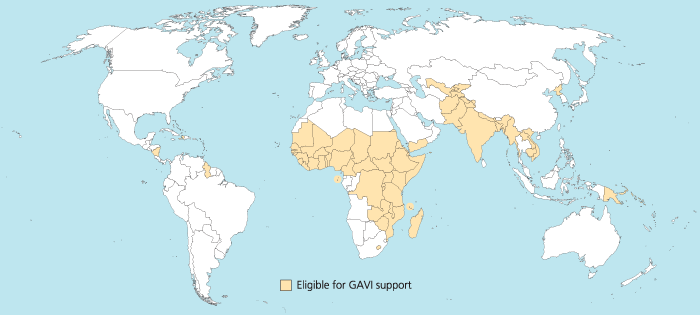
map_GAVI-eligible_countries_700x315_700

I started to use the R package rworldmap because it seemed the most appropriate for this task. Everything went fine. Most of the time was spent converting the list of countries from plain English to plain “ISO3” code as required (ISO3 is in fact ISO 3166-1 alpha-3). I took my source from Wikipedia.

Well, that was until joinCountryData2Map gave me this reply:

54 codes from your data successfully matched countries in the map
3 codes from your data failed to match with a country code in the map
189 codes from the map weren’t represented in your data

I should have better simply read the documentation: there is another small command that needs not to be overlooked, rwmGetISO3. What are the three codes that failed to match?

Although you can compare visually the map produced with the map above, R (and rworldmap) can indirectly give you the culprits:

tC2 = matrix(c("Afghanistan", "Bangladesh", "Benin", "Burkina Faso", "Burundi", "Cambodia", "Cameroon", "Central African Republic", "Chad", "Comoros", "Congo, Dem Republic of", "Côte d'Ivoire", "Djibouti", "Eritrea", "Ethiopia", "Gambia", "Ghana", "Guinea", "Guinea Bissau", "Haiti", "India", "Kenya", "Korea, DPR", "Kyrgyz Republic", "Lao PDR", "Lesotho", "Liberia", "Madagascar", "Malawi", "Mali", "Mauritania", "Mozambique", "Myanmar", "Nepal", "Nicaragua", "Niger", "Nigeria", "Pakistan", "Papua New Guinea", "Rwanda", "São Tomé e Príncipe", "Senegal", "Sierra Leone", "Solomon Islands", "Somalia", "Republic of Sudan", "South Sudan", "Tajikistan", "Tanzania", "Timor Leste", "Togo", "Uganda", "Uzbekistan", "Viet Nam", "Yemen", "Zambia", "Zimbabwe"), nrow=57, ncol=1)
apply(tC2, 1, rwmGetISO3)

In the results, some countries are actually given in a slightly different way by GAVI than in R. For instance “Congo, Dem Republic of” should be changed for rworldmap in “Democratic Republic of the Congo” (ISO3 code: COD). Or “Côte d’Ivoire” should be changed for rworldmap in “Ivory Coast” (ISO3 code: CIV). An interesting resource for country names recognised by rworld map is the UN Countries or areas, codes and abbreviations. Once you correct this, you can have your map of GAVI-eligible countries:

GAVIcountries-eligibles-map3-jepoirrier

And here is the code:

# Displays map of GAVI countries
library(rworldmap)
theCountries <- c("AFG", "BGD", "BEN", "BFA", "BDI", "KHM", "CMR", "CAF", "TCD", "COM", "COD", "CIV", "DJI", "ERI", "ETH", "GMB", "GHA", "GIN", "GNB", "HTI", "IND", "KEN", "PRK", "KGZ", "LAO", "LSO", "LBR", "MDG", "MWI", "MLI", "MRT", "MOZ", "MMR", "NPL", "NIC", "NER", "NGA", "PAK", "PNG", "RWA", "STP", "SEN", "SLE", "SLB", "SOM", "SDN", "SSD", "TJK", "TZA", "TLS", "TGO", "UGA", "UZB", "VNM", "YEM", "ZMB", "ZWE")
GaviEligibleDF <- data.frame(country = c("AFG", "BGD", "BEN", "BFA", "BDI", "KHM", "CMR", "CAF", "TCD", "COM", "COD", "CIV", "DJI", "ERI", "ETH", "GMB", "GHA", "GIN", "GNB", "HTI", "IND", "KEN", "PRK", "KGZ", "LAO", "LSO", "LBR", "MDG", "MWI", "MLI", "MRT", "MOZ", "MMR", "NPL", "NIC", "NER", "NGA", "PAK", "PNG", "RWA", "STP", "SEN", "SLE", "SLB", "SOM", "SDN", "SSD", "TJK", "TZA", "TLS", "TGO", "UGA", "UZB", "VNM", "YEM", "ZMB", "ZWE"),
GAVIeligible = c(1, 1, 1, 1, 1, 1, 1, 1, 1, 1, 1, 1, 1, 1, 1, 1, 1, 1, 1, 1, 1, 1, 1, 1, 1, 1, 1, 1, 1, 1, 1, 1, 1, 1, 1, 1, 1, 1, 1, 1, 1, 1, 1, 1, 1, 1, 1, 1, 1, 1, 1, 1, 1, 1, 1, 1, 1))
GAVIeligibleMap <- joinCountryData2Map(GaviEligibleDF, joinCode = "ISO3", nameJoinColumn = "country") mapCountryData(GAVIeligibleMap, nameColumnToPlot="GAVIeligible", catMethod = "categorical", missingCountryCol = gray(.8))

Today is world diabetes day (Merck ends MK-0431E)

As WHO and other organisations are celebrating World Diabetes Day (WDD) it is always sad to read that a new potential drug is stopped.

This time Merck & co. stopped the clinical trial MK-0431E studying the co-administration of Sitagliptin and Atorvastatin in inadequately controlled Type 2 Diabetes Mellitus. Merck cites “business reasons” without further explanations.

Sitagliptin is sold under the trade name Januvia. It is an oral antihyperglycemic and one of the (if not the) best selling product of Merck with US$975 million revenue in the third quarter of 2012. On the other hand Atorvastatin is a statin lowering blood cholesterol. It was a blockbuster for Pfizer (sold under the trade name of Lipitor) until its patent expired.

Combining these two molecules made biological sense in order to reduce the number of medications that diabetic patients take. Of course combining two blockbusters (including one which patent expired) is a nice attempt to maintain drugs and positions on market.

Happy Halloween! (Pharma Q3 results and job losses so far)

Happy Halloween! It’s the season for Q3 reports a bit everywhere so also in Pharma: Abbott (↑), Elan (↑), Eli Lilly (↓), Bristol-Myers Squibb (↓), Sanofi (↓), Novartis (↓), Shire (↑), AstraZeneca (↓), Merck & Co (↑), Novo Nordisk (↑), GlaxoSmithKline (↓), …

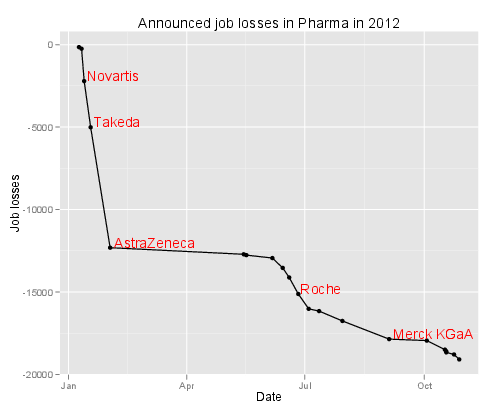
At approximately the same time came a FirstWord List about the largest layoffs in Pharma so far (2012) … I just plotted the losses so far below. Spooky!

Layoffs in Pharma so far (2012)

Idea shared #2 – the feedback toothbrush

After the T-shirt that measures your sleep better than an app, here is idea #2: the toothbrush that provides some feedback.

The idea is simple – so simple it was already applied elsewhere. The idea is to provide feedback about the quality of the way people brush their teeth. The Brushduino focuses on entertaining kids to keep them brushing at the right place for the right amount of time. Other projects (with many variants) focus specifically on time spent brushing.

I think embedded projects can go an extra mile (provided they are small enough). You can embark a gyroscope and take into account the types and amount of movements you make while brushing your teeth. This way you also have the time you did it anyway. The toothbrush could communicate with a computer to transmit the data. I guess being offline would save some space at the price of direct feedback. This direct feedback could also come in a simplified way, a bit like the Nike+ Fuelband does: it is not an exact measure that you need but merely the fact you brushed vigorously enough and during enough time. The way a gyroscope work should give the space covered – indirectly if you covered every teeth (to be checked). Connection of the toothbrush to a smartphone or a computer could provide the numerical data as well as some social features (as long as you think brushing your teeth can be something shared with your friends).

In terms of design it could look simply like this:

This kind of device will not replace advices given by dentists. But it can help / accompany people during their daily activities.

Would you buy this device?

Creative Commons Licence
This work is licensed under a Creative Commons Attribution-ShareAlike 3.0 Unported License.

Idea shared #1 – measure your sleep

I don’t consider having more or better ideas than others. But I gradually realized I have less and less time for some activities like programming, electronics etc. Maybe that’s how we realize we are getting older now adults. So I decided to share these ideas rather than fueling the illusory idea that I will implement them one day.

So idea 1 is about measuring sleep. I recorded animals’sleep during my Ph.D. – but it was thanks to an EEG device. I think that if you want to understand or improve something you have to first measure it in a way or another. So I started to try to measure my own sleep with an app (Sleep Cycle). But despite its good reviews it doesn’t work, at least for me.

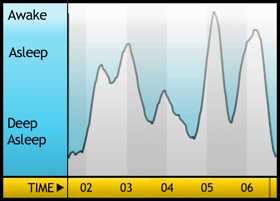
For instance the chart below is supposed to represent my sleep cycle for the night of the September 14th, 2012. I was certainly not in deep sleep at 1.30AM (baby did not want me to sleep immediately). I also woke up around 4AM (baby was again the reason). And I woke up at 6.45 (with a backup clock – had to wake up for work)?

My Sleep Graph with Sleep Cycle app for September 14th, 2012 night

The last version of the Sleep Cycle app improves things a bit by providing more statistics (so at last you can rely on the approximate time slept and compare your “sleep” across days etc.), more beautiful gaphs and the ability to download raw data. Don’t be fooled however, “raw data” means only start time, end time, sleep quality (how is it measured?), time in bed, number of wake ups and sleep notes. You unfortunately won’t be able to reproduce anything like the graph above.

Hardware devices like the Wakemate or the Zeo might give better results because part of the solution is using a real accelerometer. But the Up story shows that not everything is obvious in this world.

For me the fundamental flaw is to rely only on body movements to detect, quantify and even score sleep. Of course there is an abundant scientific literature about how muscle tone (of different muscles) is related to sleep stages (see here and here for introductory texts). But this is often measured by electrodes glued on your body.

So I think it could be very easy to develop a simple, cheap “sleep T-shirt” with light electrodes that will just stick to your body when you sleep (and you put enough of them so at any time at least some of them are connected). In fact it might happen that the Rest SleepShirt would already do the job – it’s a pity they don’t elaborate more on how they measure and collect data (but I understand they will want to sell the product later on ;-)). In my idea light wires would then go to a small pouch where they would be connected to something like a LilyPad Arduino (because it is flexible and can be sewed to a T-shirt – there may be other devices available). The LilyPad would serve as data collector or as data transmitter to a computer / a smartphone / a specific receiver (coupled to a real clock, like the Zeo). The advantage would be to remain sole owner of your sleep data – but of course the business plan should include some “social” features 😉

In the end it should look a bit like this:

Idea shared #1 - measure your sleep with sleep T-shirtThe other advantage would be that in such way you may also measure electrical activity through the body.

Will it work? I’m sure of it. Will it be enough to sleep correctly? I don’t think so: it’s not because you measure something that it improves. But at least you will have some clue on what is going on. Some other advices may be interesting. And for the moment nothing replaces a visit to a real doctor / sleep specialist!

Creative Commons Licence
This work is licensed under a Creative Commons Attribution-ShareAlike 3.0 Unported License.

Forget pills, here comes e-pills!

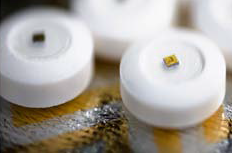
The US FDA recently approved Proteus Digital Health Ingestion Event Marker (IEM). Basically, it’s a pill with some electronics attached (very tiny electronics: around 0.5mm in diameter for a total weigth of 5mg, see picture below). Once activated the pill transmit a signal and, coupled with a detector, you know when the pill got into your body.

Edible sensor for electronically confirming adherence to oral medications.
Edible sensor for electronically co-encapsulated with a drug product using a sensor-enabled capsule carrier (from Au-Yeung et al. at Wireless Health 2010)

When you think of it, it seems very interesting. The direct potential application (Proteus is only making the IEM, not the pill itself on which the IEM is attached) is to monitor when a patient actually take her/his pills. Or for the patient, just to remember if the pill was taken already or not (you can also use boxes with specific places for each day). Some people see here a plot against human health in general – maybe. But as I use to say: watch the use, don’t punish the tools. The IEM could of course be used to ensure patient’s compliance and increase the surveillance. But on the other end, the IEM could also help decide if a properly taken medication (from “Big Pharma” or from “natural products”) is indeed efficacious.

Another direct application is the correct identification of pills before consumption. There are a lot of websites that will help us correctly identify pills found outside boxes at home (see here for instance). If you activate the IEM on a pill, the signal emitted can directly tell you which medication it is. Provided the signal emitted contains an unique signature.

And there I have some questions … Kit Yee Au-Yeung and her colleagues published an abstract (PDF) at Wireless Health 2010 about the technology. The detailed paper explains well some aspects of the IEM like the way the battery actually uses the patient’s body fluids to power a redox reaction (very simple – hence clever to use it here). But the paper doesn’t say the distance at which the signal can be recorded nor how this signal is encoded.

Antenna Antenna montaggio completo (amplificatore e elementi radianti)How far can you measure the signal from this IEM? The paper states that the “communication process remains entirely within the body; it is unnoticed by and not detectable beyond the patient consumer“. It goes into several measures during the reported clinical studies but does not mention how far the signal can be measured. In my opinion, the IEM signal cannot be detected from very far for various reasons: the statement copied above, the output of this type of redox reaction and size of substrate used and the way they define their scheduling adherence. In this definition, a “sensor-enabled medication was considered taken “on-time” when ingested within ± 1 hour and ± 2 hours of the specified time“. Since the IEM is activated as soon as in contact with body fluids and the sensor/detector is placed approximately next to the stomach, I guess the sensor only detects the IEM signal when the IEM actually reaches the stomach. I wonder if one would place the sensor just below the throat, will the time-to-detection be shortened?

COS6100A OSCILLOSCOPE 100MHZHow is the signal encoded? The paper reports an identification accuracy of 100%, meaning all detected sensors were correctly identified. It also reports a sensitivity of 97.7%, meaning the study did not detect the negative controls in 97.7% of cases of ingested negative controls. Good. Now what happens if you ingest several different medications at the same time? They will most probably reach the stomach at the same time too and their respective signals will be detected at the same time. The paper says that the sensor/detector “interprets the information from the edible sensor, identifies it as unique“. How? We don’t know. From previous experiment I know it is feasible to encode a somehow unique signal in 5mm of electronics. Up to how many different signals can be encoded (and decoded, given a weak signal)? This will give the maximum number of e-pills you can ingest at the same time.

Although the FDA only approved it for placebo pills so far, it is a very interesting first step towards the control/cure of chronic diseases, sometimes requiring to follow a long-term medication plan. Although the pill is kind of passive and the whole system (*) only measures when a pill is actually ingested, more active e-pills will come to market, for instance only releasing one of their drugs when receiving a signal or delivering a dose adapted to the environment in which they are. Later on you can imagine e-pills acting like Proteus (sic!) in the Fantastic Voyage

A video for the end? There is an official video on Vimeo but I like this one:

(*) the whole system involves a wearable sensor/detector/patch as well as a “social” application on smartphone. The sensor was already approved by the FDA a long time ago (under the name of “Raisin Personal Monitor”). From the official screenshot the app also reports activity (including sleep), heart beat, blood pressure, etc. (as many other apps around now). Could be cool to try this!

Photo credits: antenna picture by Giacomo Boschi on Flickr (CC-by) and oscilloscope signal by Mikael Alternark on Flickr (CC-by).

Effects of Tobacco on health – visualized

As you probably know I am interested in both diseases (and health in general) as well as visualization. Recently Online Nursing Programs (*) invited me to have a look at their latest infographics about the effects of tobacco on health (directly to figure).

Although numbers seem correct (references are at the bottom), although they intelligently re-use the presentation of some well-known tobacco companies, there is one thing that I don’t like that much: like this sentence, the figure is very, very long. You have to scroll many pages in order to see everything. It may look like a story but it is not presented as such (I mean: there are no clear marks of different steps in the story, except the three “chapters”). On the right is the complete figure in exactly 800 pixels of height – can you read something? GOOD.is solved this issue by using a Flash player that allows the viewer to woom in/out and go to different sections of the figure (see here for instance).

Now, about smoking … Smokers do what they want with their health. Of course, I criticise the physical dependency, the effects on social security and indirectly on everyone’s capacity to react to other health issues. And of course I hope that people could stop smoking. But in my opinion the most disgusting thing about tobacco is secondhand smoking (aka. passive smoking): the inhalation of smoke by persons other than the active smoker. This passive smoking is especially harmful in young children. The CDC estimated that it is responsible for an estimated 150,000–300,000 new cases of bronchitis and pneumonia annually, as well as approximately 7,500–15,000 hospitalizations annually in the United States – both in children below 18 months. And in adults, passive smoking increase the risk of heart disease and lung cancer by 20-30%. Without doing anything – just inhaling smoke from your neighbour.

So it was a very nice idea from them to draw people’s attention to these health issues. It could have been better if the figure would have been more “readable” IMHO.

(*) Unfortunately for them, “Online Nursing Programs” sounds like a website that will just ask for your credit card number although they publish nice infographics – like this other one about sanitation. The About page that doesn’t say who they are add to these doubts.

Created by Online Nursing Programs, license CC-…

Eat meat or not?

It all started with a strong statement in the LA Times:

If early humans had been vegans we might all still be living in caves.

It says nothing and everything at the same time … Not eating meat would have stopped our “evolution” from early humans? Not eating meat would make us dumber? Or does it have something else to do? It does.

The original article on PLoS ONE is in fact a study about the impact of carnivory on human development and evolution. And the method used is a model of weaning in Mammals (thus no intelligence test per se). Psouni and her colleagues showed that:

  • Brain mass is a better fundamental predictor of time to weaning than is female body mass (figure 2);
  • Limb biomechanics is a predictor of time to weaning (figure 3);
  • Dietary profile is a predictor of time to weaning (figure 4) and that
  • Time to weaning in humans is quantitatively predictable from a carnivorous diet (figure 5).

So eating meat made human women wean more rapidly than if we stayed vegetarian. Their model suggests that “the contribution of carnivory was to shorten the duration of lactation and suckling despite the overall prolongation of development associated with increased adult brain mass”. Nothing about intelligence thus.

However this paper came to my knowledge after OAD published a (quite long) infographics about the dangers of red meat (not meat in general). On the presentation-side, I’m not sure such long vertical banner is powerful enough: after some time you are tired to scroll down. On the content-side, it’s a well-known fact that red meat comes with a lot of healthy risks. On top of that, the infographics focuses a lot on the USA, one of the countries where the consumption of red meat is high. This reminded me a TV programme from Jamie Oliver where he showed how meat is processed in the USA …

It’s “good” to be reminded of all this only once you’ve come back from there …

Key messages? Always read the original paper (even diagonally it’s better than general press) and know what you eat!

Edited on May 12, 2013 to remove the link to the original infographics (as it was not present anymore).

Pi in Pubmed

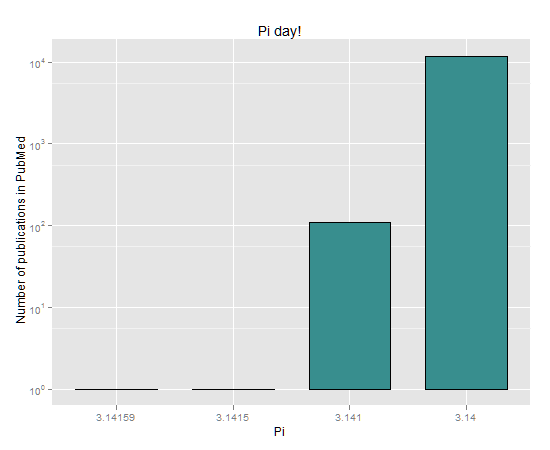
On March 14th, 2012 (3/14/2012), it was Pi day. According to Wikipedia, Pi (π) is a mathematical constant that is the ratio of any Euclidean circle’s circumference to its diameter. While others estimated π using Monte Carlo in R or declared π is wrong, I tried to see how many times the pi value is cited in Pubmed, a database of references and abstracts on life sciences and biomedical topics. And here are the results (please note the log y-axis):

Pi citations in Pubmed (March 2012)

Pi Occurences
3.14159 1
3.1415 1
3.141 110
3.14 11726

I know it has little meaning: very often the string of numbers in the pi value was not there for pi itself but for other reasons. I thought it was fun, that’s all.