Category: Health

Yesterday was International Day of Older Persons

On 14 December 1990, the United Nations General Assembly designated 1st of October the International Day of Older Persons. 1990 … it is already more than 20 years ago! People who signed the resolution at that time are now more than 20 years older. Some (most) of them probably are now considered as “old persons”. Do they still have the same view on elderly? Maybe the highlighted principles at that time (independence, participation, care, self-fulfilment, dignity, …) are too broad, too short, just enough?

So, already a century ago 😉 people were concerned by the dramatic changes in the composition of the world population. Thanks to progresses and greater availability of preventive measures and treatments more people are living longer and healthier. Even in countries where fertility rate is high, there will be less and less working-age adults per older adult. When you look at China, the percentage of people above 65 years old is projected to rise up to one fourth of the total population in only 40 years.

Actual and projected percentage of people above 65 in China
Actual and projected percentage of people above 65 in China (partial data from Leeder et al., Columbia University, 2005)

Imitating other countries like the USA, UK, the Netherlands, etc., Belgium recently launched its Open Data Initiative. Well, don’t expect fancy graphs nor any “web 2.0” widgets, it’s only a repository of data made available elsewhere. Most (if not all) data is provided “as it is”, in proprietary formats and not easily combined nor even visualized. So I welcome this initiative but just wish it will be at least maintained and updated or, better, grown into something better, just like other government open data websites. A dream will be to have at least direct data manipulation online, downloads in open formats, a clearly open license and why not an open API?

So, what about the elderly in Belgium? There is a section about population forecast by age (which comes from the economy ministry in Excel format).

Projected aging of population in Belgium
Projected aging of population in Belgium (data from http://data.gov.be)

The Belgian population will continue to increase. The older population in Belgium will increase faster than the younger population. But seen like this, the growth will not be very dramatic.

Actual and projected percentage of people above 65 in Belgium (data from http://data.gov.be)

If we look at the projected percentage of people above 65 years old, we see that Belgium in 2010 is already at the same status as China in 2040. If experts say China will have an alarming percentage of old people in the future, the future is already here in Belgium! But it’s also true that Belgium took many decades to achieve this allowing some adaptations to take place. China will achieve it in only a few decades and will have to cope with these changes very quickly.

UN highlighted some challenges and ways to overcome them at a country / government level. The main issues will be to maintain older people as much as possible the same levels of health and independence as they enjoyed during their active lives.

N.B. For other sources of data in Belgium, one may be interested in visiting the Bureau fédéral du Plan, Statistics Belgium and the Statistics section of the National Bank of Belgium.

NCDs account for the majority of deaths worldwide

A few days before my last post and still about the UN High Level Meeting on Prevention and Control of Non-communicable Diseases, The Economist issued a daily chart showing that non-communicable diseases (NCDs) account for the majority of deaths worldwide. I copy the chart below:

The Economist: non-communicable diseases account for the majority of deaths worldwide

I have nothing to add about the chart on the left (except I don’t think stacked bars are really useful to visually distinguish between quantities ; ok, I added something). My first reaction to the chart on the right was: these countries in the lower middle income group should really do something to tackle non communicable diseases: they represent more than the double amount of deaths than the total number of deaths in other income groups. Even for communicable diseases, they should do something: from the chart, it seems to be a bit less than 10m deaths from communicable diseases, i.e. approximately the same amount as the total number of deaths in other income groups too!

Just for you information (and because I also had to recall which countries were in that lower middle income group), here are some countries in the various groups (*):

  • Low income group: Afghanistan, Bangladesh, Ethiopia, North Korea, Nepal, Somalia, Togo, a.o.
  • Lower middle income group: Angola, Bolivia, Congo, Georgia, India, Iraq, Morocco, Pakistan, Sudan, Ukraine, Vietnam, a.o.
  • Upper middle income group: Algeria, Brazil, China, Cuba, Libya, Malaysia, Russian Federation, Serbia, South Africa, Thailand, a.o.
  • High income group: E.U. countries, Japan, Singapore, Switzerland, USA, a.o.

(*) Technically it follows the way the World bank classifies countries: economies are divided according to 2010 GNI per capita, calculated using the World Bank Atlas method. The groups are: low income, $1,005 or less; lower middle income, $1,006 – $3,975; upper middle income, $3,976 – $12,275; and high income, $12,276 or more.

Then you realize that if you just take the absolute number of deaths and compare these group of countries (as it’s done in the chart on the left), you don’t compare exactly on the same basis. What if some groups have more countries or lower/higher population? What if the total surface of countries in one group are much higher (lower) than in other groups? Idem for the population density, etc.

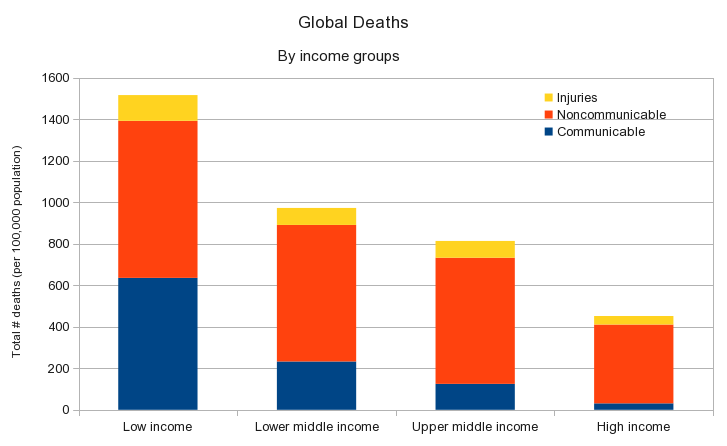
Fortunately, the WHO has a parameter one can use in order to objectivize a little bit this issue: the “Age-standardized mortality rate by cause (per 100 000 population)”. If you plot this parameter in the same way as above, you obtain this chart:

Age-standardized mortality rate by cause (per 100 000 population) per income group

From this you can now say that low income countries should really do something about NCDs but also communicable diseases, etc.

Presented like this, the number of deaths due to injuries and communicable diseases (per 100,000 pop.) decreases if the income of the country increases. In other word, more income you have, relatively less risk you have to die from injuries or communicable diseases. That explains why 1 death under a fallen wall is reported as a big sad news in Belgium while 60 deaths in a bus crash are not even reported in the news in India.

Another striking conclusion is that in low income countries there is approximately the same number of deaths (per 100,000 pop.) due to NCDs and due to communicable diseases (+/- 20%). We are all aware of tuberculosis, malaria, AIDS/HIV, etc. in less rich countries but it seems NCDs are an equally important issue.

But the most frightful conclusion from these numbers is that there is approximately the same number of deaths (per 100,000 pop.) due to NCDs in all income groups (674 ± 75) except the high income one. In other words, irrespective of you location or your income (except high income), you have the same chances to be affected by a non communicable disease. And irrespective on your income (and this time, even for high income countries), you have more chances to die from a non communicable disease than a communicable disease.

Ways to mitigate risk factors for NCDs (end of previous post) are still on.

N.B. WHO numbers are from 2008 for both charts.

The state of non communicable diseases

Last week, United Nations gathered in New York, USA, to talk about prevention and control of non-communicable diseases (NCDs). Non-communicable diseases are non-infectious, of long duration and generally progressing slowly. Due to the fact they are not infectious, there is no pathogen to target and there is no transmission medium to fight. Due to their long duration and slow progression, one usually notices NCDs when it’s too late and eradicating NCDs is less spectacular than other (not less important) infectious diseases. However WHO measured that NCDs represents more than 60% of all deaths in the world. For the occasion, WHO released an introductory video that summarize the issue.

So there are 4 main non-communicable diseases:

  1. Cardiovascular diseases
  2. Diabetes (both of them represent 70% of deaths by NCDs)
  3. Cancers (~ 20% of deaths by NCDs)
  4. Chronic respiratory diseases (~ 10% of deaths by NCDs)

NCDs are not directly in the UN Millenium Development Goals but I already mentioned they represent 4 of the top 5 killers in the USA. Two of them are also in the top 5 killers worldwide. If the Millenium Goals succeed, non-communicable diseases will be the next big issue in health.

Although NCDs were considered as a disease limited to high income countries (with infectious diseases affecting low income countries), this is not really the case anymore. For instance, the map of male deaths due to cardiovascular diseases and diabetes in 2008 shows an approximately uniform rate in high income countries with some higher rates in low income countries (especially on the African continent).

World : Cardiovascular diseases and diabetes, death rates per 100 000 population, age standardized: Males, 2008
WHO World : Cardiovascular diseases and diabetes, death rates per 100 000 population, age standardized: Males, 2008

If you are looking for more numbers, visit the WHO Global Health Observatory on Noncommunicable diseases.

If nothing is done, the incidence of NCDs will increase. On top of being a health issue, a matter of life and death, it will also become an economical problem as the costs of treatment as well as the indirect costs will also dramatically increase (increase per case treated and increase due to the number of cases treated).

Incident cases and cost of diagnosed diabetes per 1,000 people
Incident cases and cost of diagnosed diabetes per 1,000 people (adapted from Boyle et al. 2010 and Alternative Futures Diabetes 2025)

If you are looking for more figures about the cost of non-communicable diseases, here are two detailed reports recently published:

In a nutshell, non-communicable diseases are everywhere and the future doesn’t look happy. However …

However risk factors are identified and many of them are related to our own lifestyle:

  • Physical inactivity
  • Unhealthy diet
  • Tobacco use
  • Harmful use of alcohol

To end on a positive note, all these risk factors can be easily controlled and for a limited additional cost. For instance, governments can protect people from tobacco (taxes as well as bans on tobacco advertising, promotion and sponsorship, …) and alcohol (access restriction, bans on advertising, …) as well as promote public awareness about diet and physical activity. Companies can also promote healthy diet and physical activities to their employees. On top of that, the food industry can also include relevant actions in their corporate social responsibility policies. Finally on a personal level, we can increase our physical activity, increase fruit and vegetable intake, reduce our use of tobacco and alcohol, etc. Simple, cheap actions ; huge interesting consequences.

OS need an immune system and not a CDC-like

In an IT World article, Tom Henderson gives many details about a US-government-led CDC-like organisation to fight malware. In summary, he states that companies and consultants providing security and prevention around operating systems don’t have any real motivation to eradicate malware. And in case of an “outbreak” of these malware, he added one needs a US government body to look after every computer “health”, coordinate the surveillance and the response. He even pushes the comparison with the human medical system by introducing a Hippocratic Oath for computer healthcare.

With all the respect I have for someone I’ve never heard of before, I think Tom Henderson misses one crucial point that make his flight of lyricism totally irrelevant. The missed point is that human beings (as well as every animal species and especially vertebrates) have a immune system. It’s our immune system that gives the first answer to any external “invasion”, it’s our immune system that can adapt to the diversity of threats out there, it’s our immune system that allow our body to recover.

Today computers have a nice body, nice mechanics. Operating systems are behaving like we tell them, not as separate entities. We constantly add foreign bodies (software) and they are constantly in contact with potential external aggressions (via file exchanges, media insertion, network connections). What we begin to give them are sentinels monitoring critical parts of the system, a kind of basic neural system. We invented the body-in-the-body (virtualization) to prevent one failing organ (software) to contaminate the remaining parts of the body (a.o.). We also give some vitamins (firewalls e.g.), strengthening  some defences. And finally we think that “anti-virus software” are enough while it’s only some kind of very basic, un-natural innate immune system.

Before thinking of a CDC-like body for our computers security, one should maybe think of adding a immune system to our computers. At least a basic one, where there is a response even to currently unknown threats. Then we might think of something more sophisticated, with memory and specific response. Look, there was no network, no communication outside: the body/computer can easily cope with the threat by itself. Research is already looking at such applications. And, yes, finally, if you insist, bring your CDC-like organism.

Today is World Population Day

Today, 11th of July 2011, is World Population Day. For that occasion, and as the world population is expected to surpass 7 billion this year, the UNFPA is launching a new campaign: 7 billion people – 7 billion actions.

7 billion actions poster - UNFPA

They highlight 7 key issues to explore:

  1. Poverty and inequality: reducing poverty and inequality also slows population growth.
  2. Women and girls: unleashing the power of women and girls will accelerate progress on all fronts.
  3. Young people: energetic and open to new technologies, history’s largest and most interconnected population of young people is transforming global politics and culture.
  4. Reproductive health and rights: ensuring that every child is wanted and every childbirth safe leads to smaller and stronger families.
  5. Environment: all 7 billion of us, and those who will follow, depend on the health of our planet.
  6. Ageing: lower fertility and longer lives add up to a new challenge worldwide: providing for aging populations.
  7. Urbanization: the next two billion people will live in cities, so we need to plan for them now.

These issues are not new. They are not even original: most bodies or meetings looking at issues for the future have approximately the same issues. But at least it’s another initiative to raise awareness, to think about them. And, most importantly, to act to tackle them.

I don’t think it’s wishful thinking to write that everyone can help. Besides being in the introduction brochure, teaching a child to read, planting a tree, visiting a senior, finding a cure, standing up for others and making someone smile are all simple actions we can do (even if we can’t do all of them, we can do some of them). We can start with our own kids, our own family, our own environment.

What will be your unique story?

Sometimes people are really stupid

I just read that orange agent is used in Brazil to clear the Amazon. I am not judging people who may be forced by their living conditions to do this (although I doubt people who did this are poor since they sprayed it by plane). It may be the cheapest way to clear a forest to use the land for pasture (although I doubt buying chemical and spraying it by plane is cheap). But …

Agent OrangeBut this is already very stupid because since at least the Vietnam war, we know that the orange agent is a very toxic product with detrimental effects on human health (in the USA, the Veterans Affairs are busy with that). On top of already using the orange agent to clear forests for mining, these guys thinks it will be interesting to go there and take care of the livestock. They will of course quickly earn money from selling meat from animals that grew there. But they will face health issues, at some point, for them and most probably for people who will eat that meat.

Because that’s the second stupid thing they are making: cows, horses, goats, sheep, etc. that will graze there will also be contaminated. In the worst case (for them), their meat will immediately be unfit for human. In the worst case (for everybody), the meat will be sold to people outside contaminated zones and these people will also be contaminated …

I will not be surprised if I read news about baby malformations in the coming years in Brazil. And I’m wondering why Monsanto is still selling orange agent anywhere in the world. Is money so important compared to human health?

Photo credit: Agent Orange by Emilio Labrador on Flickr (CC-by)

The Top 5 Killers of Men

From Delicious, I saw that Yahoo had an article about the top 5 killers of men. I thought it would be nice to see from where they get there data.

First, I have to mention that the article is really about American men, nothing else (not about mankind, not about men around the world, not about women, children, etc.). The article is related to the US National Men’s Health Week (the US National Women’s Health Week was in May 8-14, 2011). Although the article is giving advices, there are no sources of information.

However, it’s rather easy to obtain these numbers …

For the US, the CDC FastStats website is a hub to data about health in the US. Here is the CDC ranking for the top 5 killers in 2007 (in both US women and men):

  1. Heart disease: 616,067 deaths
  2. Cancer: 562,875 deaths
  3. Stroke (cerebrovascular diseases): 135,952 deaths
  4. Chronic lower respiratory diseases: 127,924 deaths
  5. Accidents (unintentional injuries): 123,706 deaths

If you look at the whole world (data from the UN), the picture is somehow different! The UN ranking for the top 5 killers in 2008 (in both women and men) is:

  1. Lower respiratory infections: 1.05 million deaths
  2. Diarrhoeal diseases: 0.76 million deaths
  3. HIV/AIDS: 0.72 million deaths
  4. Ischaemic heart disease: 0.57 million deaths
  5. Malaria: 0.48 million deaths

All of them causes more than 45% of deaths around the world. These diseases with high-mortality vary in an important manner when we compare the USA and the whole world. The main caveat is that the data I presented above are for men and women. It would be interesting to use the UN data API project to dig further into details.

March 24th was world TB day

TB stands for tuberculosis. It’s an infectious bacterial disease caused by Mycobacterium tuberculosis, which most commonly affects the lungs. It is transmitted from person to person via droplets from the throat and lungs of people with the active respiratory disease.

Like all other World Days regarding infectious diseases, it is meant to raise awareness about its global epidemiological aspects and the efforts to eliminate it. For tuberculosis, March 24th was chosen because Robert Koch first described Mycobacterium tuberculosis on March 24th, 1882. He then received the Nobel Prize in Physiology or Medicine for this in 1905.

On the WHO website, there is a huge amount of data that can be easily parsed (here too).

I was first interested in the estimated TB incidence per 100 000 population in 2009 (per 100,000 population) in the BRIC countries (see table below). Clearly, there is Brazil with a low incidence (compared to others, it’s still around 10 times values found for “occidental” countries) then Russia and China around 100 cases/y and finally 168 cases/y for India. I added their respective Gross Domestic Product (GDP) in the table as it’s often considered as an indicator of a country’s standard of living (in 2009, numbers from Wikipedia/IMF). I also added the annual growth rate of GDP per capita (in 2006, numbers from EarthTrends/World Resources Institute). The only interesting thing I see is that if your annual growth of GDP per capita is low, your estimated TB incidence per 10,000 is also low.

Country Est. incidence GDP per capita Annual growth rate …
Brazil 45 11,289 2.4
China 96 7,518 10.1
India 168 3,290 7.7
Russian Federation 106 15,807 7.2

Now if we look at some occidental countries (table below, same sources), this seems right.

Country Est. incidence GDP per capita Annual growth rate …
Belgium 8.6 36,274 2.6
France 6.1 34,092 1.4
Germany 4.9 35,930 2.9
Japan 21 33,828 2.2
UK 12 35,053 2.2
USA 4.1 47,123 1.9

The treatment involves medications for long period and is usually accompanied by antibiotics. Regarding prevention, Bacille Calmette Guerin (BCG) is the only current vaccine for tuberculosis and contains a live attenuated (weakened) strain of Mycobacterium bovis. TB eradication is part of the UN Millenium Development Goals (Target 6c: Have halted by 2015 and begun to reverse the incidence of malaria and other major diseases). It is also part of the WHO Global Plan to Stop Tuberculosis.

Recently (because of this World TB Day?), two interesting research papers were recently published in the litterature:

Today is *not* World Epilepsy Day

I continue in the serie of “World x Day” and for a reason still unknown even to myself, I thought today was the World Epilepsy Day (it’s in fact on March 26th, called Purple Day). But, anyway, epilepsy is “a common chronic neurological disorder characterized by seizures. […] Epilepsy is usually controlled, but cannot be cured with medication, although surgery may be considered in difficult cases.” (Wikipedia).

Out of curiosity, I was looking for mathematical models for the description of the epidemiology of epilepsy. But unfortunately, I couldn’t find anything. Probably because epilepsy is not an infectious disease for which tentative mathematical models have more predictive power (in terms of the population scale and time scale). The epidemiology of noninfectious diseases is primarily a study of risk factors associated with the chance of developing the disease. Nothing very fancy for a mathemarical model! 😉 (But if you find something, feel free to share! Thanks in advance!)

According to Wikipedia, the next World [Infectious Disease] Day is on APril 25th (malaria).

So today is just Valentine’s Day 🙂

World Cancer Day

It doesn’t seem jolly but last Friday, it was the World Cancer Day. About this, the WHO set up a nice website about cancer control.

Following my previous post on Jamie Oliver and the top 15 causes of death in the USA, I started to collect similar data from other countries. Linking this to cancers, the annual statistics on cancers in Belgium can be found on the Belgian Cancer Registry. The latest numbers are however from 2006. Here are the top 15 cancers in Belgium in 2006 (all sexes and regions mixed):

Rank Classification Cancer type Cases Remark
1. C50 Breast 9556  
2. C61 Prostate 9254 male only
3. C34 Bronchus and lung 6956  
4. C18 Colon 5233  
5. C44 Malignant neoplasms of skin 3110  
6. C20 Rectum 2264  
7. C67 Bladder 1986  
8. C82-85 Non-Hodgkin-lymphom 1925  
9. C43 Malignant melanoma of skin 1572  
10. C64 Kidney 1377  
11. C16 Stomach 1356  
12. C54 Corpus uteri 1320 female only
13. C25 Pancreas 1172  
14. C80 Unknown primary site 1168  
15. C15 Oesophagus 920  

It’s interesting to note a few things:

  • These figures represent cases of cancer and not deaths by cancer. Note also that prostate cancer is in third position but only concerns males.
  • The latests data is from 2006. The website doesn’t seem to be updated since 2008 (and 2008 seems to be the year when data from 2006 are available ; if we follow the 2-years-gap logic, I guess the data from 2009 are available somewhere but not on this website)
  • Data accessibility seems to be average. Data is there in Excel format (and PDF which is pretty useless if you want to reuse the data). On one side, these Excel files can be opened by almost every office suite. On the other side, some open format would have been preferred. And some direct interaction with the data on the website is now the norm (ok, I just wrote it doesn’t seem to be updated since 2008)
  • The classification is quite good since it uses the “Classification Internationale des Maladies” which is the “International Classification of Diseases” in English better known as ICD-10 (online).